Introduction
This statement is made pursuant to section 54(1) of the Modern Slavery Act
2015 and constitutes the University of Cumbria9s Slavery and Human
Trafficking Statement for the financial year ending 31 July 2025.
Modern slavery is a crime and a violation of fundamental human rights. It
takes various forms such as slavery, servitude, forced and compulsory labour
and human trafficking, all of which have in common the deprivation of a
person's liberty by another in order to exploit them for personal or commercial
gain.
This statement provides information about the University and its policy and
practices to prevent modern slavery in its business and supply chains.
Modern Slavery Act Statement 2024-25
1. Organisation's Structure
The University of Cumbria is a UK Higher Education Institution providing a wide
range of teaching, research and related activities. We have campuses in Carlisle,
Ambleside, Lancaster, Barrow and London. The University operates from other
sites in the UK and overseas through partnership and collaboration arrangements
with education providers and other organisations.
The University of Cumbria is a company limited by guarantee and a registered
charity. We had income of £78.3m and over 10,000 registered students in 2024/25.
The overall responsibility for the strategy and control of the University of
Cumbria rests with the University9s Board of Directors. As part of their oversight of
the University9s approach to preventing modern slavery, they review and approve a
Modern Slavery statement each year, following scrutiny by the University9s
Audit and Risk Committee.
2. Policies, processes and procedures on slavery and human trafficking
The University is committed to combatting slavery and human trafficking in ail
its business practices. We have established a formal Anti-Slavery and Human
Trafficking Policy and Procedure which sets out our approach to this and have
ensured that this approach is embedded across related policies and procedures
and that it has a focus on our staff, supply chain and students.
Staff
The People and Culture team at the University are responsible for providing the
systems and processes to support effective recruitment, appointment and well-being of University colleagues working in partnership with managers and leaders
across the University, under the leadership of the Director of People and Culture.
They provide oversight, management and risk management across a range of
policies, processes and procedures which act to ensure that modern slavery
related risks are mitigated, including through:
- Ensuring full compliance with UK Visas and Immigration (UKVI) "right to
work" checks - Ensuring that those directly employed by the University were
remunerated in line with the Living Wage Foundation rate in 2024/25. - Providing routes for colleagues to raised concerns, with support to any
investigation process, with reporting as appropriate. - Protecting those raising concerns about possible instances of slavery and
human trafficking.
The University may on occasion use agencies to provide temporary staff or may sub-contract some activities. In such cases, the suppliers of these services are required
to conduct requisite employment checks and demonstrate compliance with duties
under the Modern Slavery Act.
Supply Chain
The requirement to act ethically and safeguard human rights in the supply chain
forms part of our Procurement Policy and we manage expenditure robustly in line
with this policy. The University purchases a wide range of goods and services and we are committed to enforcing effective controls to minimise the risk of modern slavery taking place.
During procurement exercises, potential modern slavery risks are identified and a
due diligence approach adopted. Suppliers are asked to provide evidence for review
that demonstrates adherence to anti-slavery principles and practices and to the
requirements of the Modern Slavery Act. All suppliers are encouraged to register
with the NETpositive Supplier Engagement (HE) Tool, allowing the University to
access data regarding the supplier's approach in this area, including within their
supply chain, and to review and discuss their action plans.
There is added scrutiny of suppliers which provide goods or services that are deemed
to be "higher risk" in terms of the potential for modern slavery to occur. Our risk
assessment of the supplier base has identified the following categories of
expenditure as being "higher risk":
- Security Services
- Hospitality and Catering
- Information Communication and Technology Equipment and Services
- Consumables and equipment
- Cleaning
- Construction and maintenance
- Clothing
The University's use of procurement frameworks helps mitigate key modern slavery
risks and provides assurance to the University of supplier compliance. The University conducts much of this procurement via the North-West Universities Purchasing
Consortium (NWUPC), who act to collate information prior to tender award on first
and second tier supply chain and then work with suppliers post contract to
encourage them to look beyond their statements and conduct robust analysis of their supply chains to identify areas of risk and the actions they are taking in mitigation.
Students
The University ensures that modern slavery risks to our students are considered as
part of our wider approach to the Safeguarding, with a specific focus on this area
within our Safeguarding and Prevent Policy. In order to ensure an ongoing focus on
such risks, the University's operational lead for modern slavery is a member of the
Safeguarding Steering Group.
3. Training and Awareness Raising
The University is committed to awareness raising and training in this area. Staff in
procurement and in other key areas complete the training provided by the British
Universities Finance Director9s Group and a University wide message was shared
which explained what modern slavery is, made clear the University9s approach
and requested all staff to view a short video exploring the major indicators that
may be taking place. This was issued to coincide with Anti-Slavery Day in October.
4. Actions
During the current year, we have completed the following key actions to further
develop our approach to modern slavery:
- Contacted a sample of existing <higher risk= suppliers to receive assurance of continued compliance with the Modern Slavery Act and the operation of
appropriate controls and mitigations. - Reviewed our approach to suppliers of lower value contracts which are not
subject to formal tendering processes and developed processes to ensure
assurance in this area was gathered. - Reviewed our supplier contracts to ensure that we clearly outline requirements
of suppliers in the area of modern slavery, including around their supply
chain. - Developed our approach to student engagement in this area and have made
available relevant information available via our online Student Hub.
During 2025/26 we will continue to embed and evaluate these actions. As part of
this we will:
- Further develop our approach to student engagement, with additional content provided in our Student Hub and by adding modern slavery to our "You Report We Support" reporting tool.
- Review our approach to training and awareness raising and formalise plans for communication and engagement such that a three-year cyclical approach is
established.
5. Approval and Signature
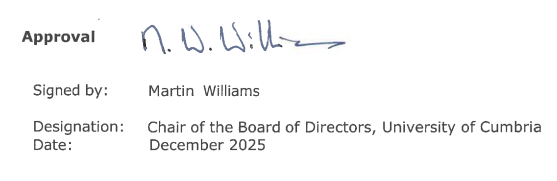
This statement is made pursuant to section 54(1) of the Modern Slavery Act 2015 and has been approved by the University Board of Directors. It constitutes the University of Cumbria's Slavery and Human Trafficking Statement for the financial year ending 31st July 2025.