
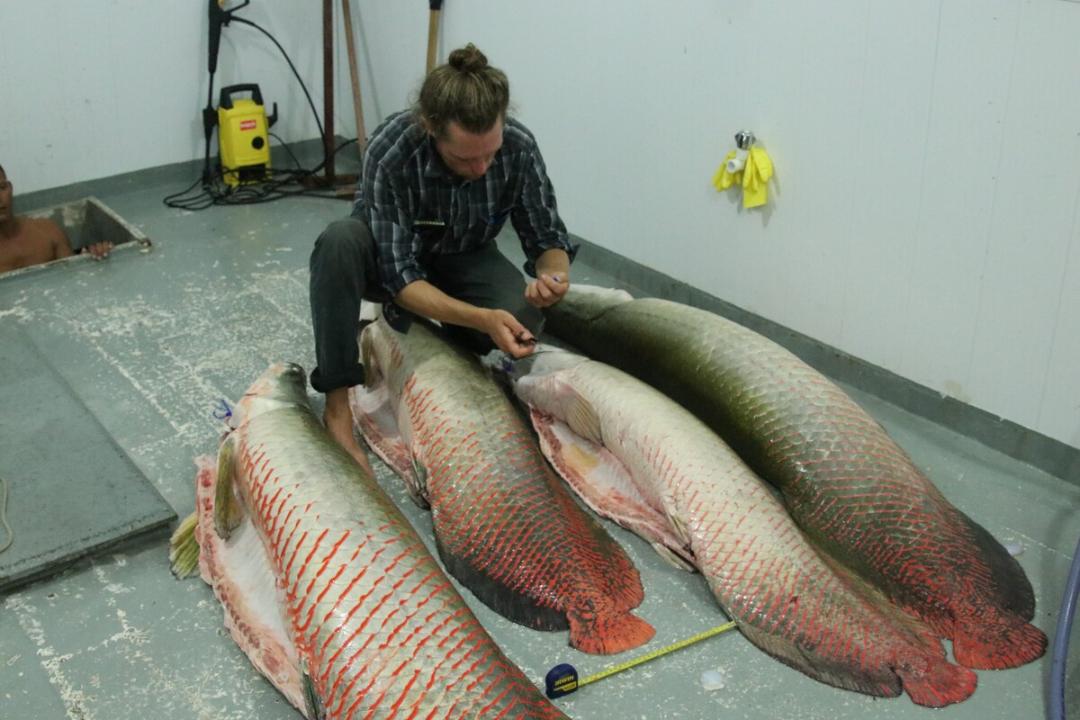
Image credit: J. Hawes
The sustainable harvest of natural resources by local communities is one of the most promising conservation strategies in developing tropical countries. In the Brazilian Amazon, a notable example is the management of the pirarucu (Arapaima gigas), one of the largest freshwater fish on Earth, where sustainable harvest practices have been shown to promote biodiversity conservation and improve social and economic well-being both inside and outside protected areas.
The success of this community-based conservation scheme relies on a good understanding of the fish population dynamics, including their movement patterns between sub-populations that are connected across the floodplain forest landscape during the annual flood season but isolated in individual lakes during the dry season. Given the challenges in employing radio and satellite tracking in this case, a genetic approach provides a particularly valuable insight into the degree of connectivity of the fish populations by quantifying gene flow between populations.
Dr Joseph Hawes contributed to a paper which examined single nucleotide polymorphism (SNP) data from tissue samples collected during annual quota harvests of pirarucu fisheries by local communities along the Juruá River, to test genetic population structure and isolation by distance. The genetic clusters identified showed strong separation between lakes upstream and downstream of the main urban centre in the region, potentially influenced by higher current and historical fishing pressure. The findings support calls to consider the degree and direction of gene flow when planning spatial zoning in the management of freshwater fisheries.
The study was conducted in collaboration with Instituto Juruá. The paper, led by Dr Julia Verba from the EqualSea Lab at the Universidade de Santiago de Compostela, is published in the journal Freshwater Biology: https://doi.org/10.1111/fwb.70187