
Impacts of human disturbance on tree diversity
Dr Joseph Hawes, Senior Lecturer in Ecology & Conservation in the University of Cumbria’s Institute of Science & Environment, and Theme Lead for Conservation & Ecology in our Centre for National Parks & Protected Areas has contributed specialist expertise to a new international study evidencing the profound impacts of human disturbance on the ecological functions and evolutionary history of the Amazon rainforest.
The research, published recently in Global Change Biology journal, demonstrates that disturbances such as selective logging, wildfires, and the clearing and regrowth of forests significantly alter the diversity and composition of Amazonian tree communities. With tropical rainforests holding most of the planet’s biodiversity, understanding these shifts is crucial to addressing the global biodiversity crisis.
The Amazon contains up to 16,000 tree species, with a single hectare often supporting more than 300 species. Yet, tropical regions continue to experience rapid forest loss and, in the Amazon, human-modified and secondary forests now cover around 23% of the remaining forest.
The study, carried out by an international research team from Brazil and the UK, involved sampling more than 55,000 trees across 215 plots in Eastern Amazonia. These plots spanned a spectrum of forest conditions, from undisturbed primary forest to selectively logged, burned, and regenerating secondary forests.
Researchers measured three key dimensions of diversity: species diversity, functional diversity (based on traits such as bark thickness, leaf area, wood density and seed traits) and phylogenetic diversity (reflecting the evolutionary relationships among species).
All forms of human disturbance were found to reduce every measure of tree diversity, reshaping both the composition and ecological roles of Amazonian forests.
Dr Hawes' work focused on the seed dispersal characteristics of Amazonian tree species. He compiled and analysed datasets on seed width, fruit type and dispersal mode, traits that influence how forests regenerate after being logged, burned or clear-felled. Seed dispersal traits play a vital role in determining which species recolonise disturbed areas and how forest composition changes over time.
The findings are presented in the paper “Multi-faceted assessment of Amazonian tree diversity reveals pervasive impacts of human modifications”, which forms part of the long-term PELD-RAS research programme funded by Brazil’s CNPq, UKRI and DEFRA’s Global Centre on Biodiversity for Climate, and the BNP Paribas Foundation’s Climate and Biodiversity Initiative.
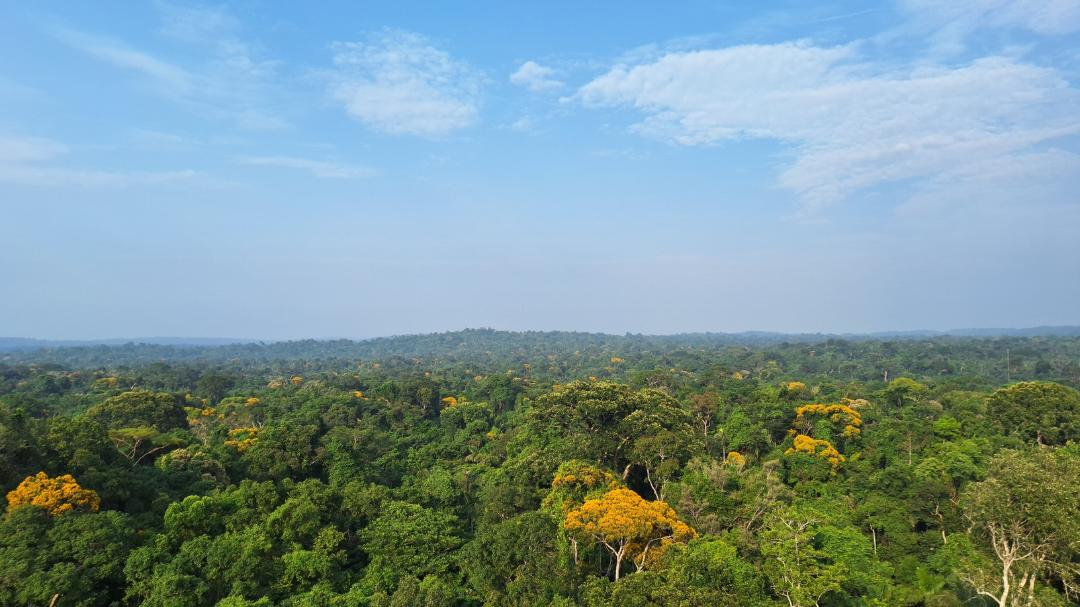
Image: Amazon rainforest, Brazil
Back to Research Theme