
Views from campus... with Dr Penny Bradshaw
Published on: 10/08/2026
Tagged:
By Joanne Lusher
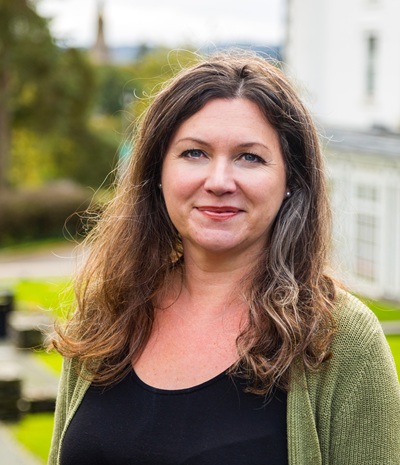
Dr Penny Bradshaw Associate Professor of English Literature
Penny has worked for the university (or one of its legacy organisations) for 25 years. Having originally taught at our Lancaster campus, she is now based at Ambleside where she is programme leader for our MA in Literature, Romanticism, and the Lake District. Penny is also theme lead for Cultural Landscapes within the university’s Centre for National Parks and Protected Areas.
Where did it all start?
I studied for my BA English at what was then St Martin’s College (now the Lancaster campus of the University of Cumbria). I didn’t really have a career plan until I began my undergraduate studies, but I fell in love with university life straight away and from that moment on I knew that I wanted to be an academic in the field of english literature.
How did you get to your current position?
Having completed my MA and PhD by 1999, I was fortunate enough to be appointed as a lecturer in english literature at what was then St Martin’s College in 2000 and, shortly after, I became programme leader for the undergraduate english literature programme. Within a few years I was promoted to senior lecturer and I went on to develop the MA in Literature, Romanticism and the Lake District. I am now programme leader for this MA which was launched in 2019. A very special milestone in my academic journey was being promoted to associate professor of english literature in 2021.
What do you love about your subject?
Everything! As someone who grew up with their nose inside a book and who lived so many other lives imaginatively alongside my own, I find it a joy to teach a subject which connects with people in so many different ways. English literature, and the humanities more broadly, are discipline areas which seem to be under threat within the wider higher education sector at the moment, but subjects which study the human condition across historical and geographical contexts are vital to our society, perhaps more so than ever at the present time. Literature has a particularly important role to play in our society, as you do not merely learn facts and figures about contexts and lives beyond your own, but you engage with them imaginatively and in ways which can often create powerful levels of understanding and empathy.
What was your lightbulb moment where you knew you wanted to teach others?
I was drawn to teaching from a very early stage and as a child was often be found giving lessons to my teddy bears! However, by the time I went to secondary school I began to feel that I didn’t want to work in a school context, so it was going to university which was my ‘lightbulb’ moment, because I realised that there was a different kind of teaching career available, one which combined teaching and lecturing with your own ongoing research development.
What is your favourite part of campus?
I love Scale How, partly because this building was originally a private residence called Green Bank and William Wordsworth’s cousin, Dorothy Harrison, lived here with her family from the 1820s. As a result, Wordsworth was a regular visitor during his later life. I also love The Armitt, a wonderful library and museum which sits at the foot of the Ambleside campus and which is currently showing my book-tie in exhibition, ‘An A-Z of Beatrix Potter’, throughout 2026: An A-Z of Beatrix Potter | ARMITT MUSEUM AND LIBRARY
What is the biggest change you have seen since you started working at the university?
I’ve seen very many changes over the last 25 years, not least in terms of my own role and the type of work I do here at the university, but also in terms of the additional demands now placed on students who now often have to juggle academic studies and paid work. What has remained consistent throughout though, and one of the main reasons why I love working at the University of Cumbria, is our academic community, which encourages and nurtures a really special and mutually supportive relationship between staff and students.
If a graduate walked into your lecture theatre today, what’s one new thing they would be surprised to learn about?
As I only teach postgraduate students these days, most of my teaching consists of seminars and tutorials rather than formal lectures. However, I do often give public lectures and if a graduate from our undergraduate programme were to attend one of these, they would probably be most surprised to learn about some of the unexpected influences on Beatrix Potter’s famous writing for children, from her early love of circuses and her work in the field of mycology, to her fascination with gothic and uncanny landscapes.
What’s your proudest achievement in your role?
Over the last 25 years many of my students and graduates have been in touch to let me know how I, and the programmes I have had the privilege to lead, have enriched and transformed their lives and I am really proud to have made a difference to so many individual lives through my work here at Cumbria.
What is your course area currently working on?
As part of their ‘Literary Tourism and Cultural Heritage’ module, my MA students are currently working on projects relating to their work experience visit days spent at key cultural heritage sites in the region (Wordsworth Grasmere, Hill Top and Brantwood).
What are you currently obsessed with? (book, tv show, band etc, something from your personal life)
So, I love themed-reading, whether it be books suited to a particular season or do with a particular place. I am going to Geneva in a few weeks and so I am currently obsessed with reading literature which has been inspired by Switzerland, from Byron and the Shelleys to more recent texts like The Swiss Summer by Stella Gibbons (1951).
What’s your idea of a great weekend?
My idea of a great weekend is one spent with my two grown up sons and wider family picnicking by a sunny lake side, walking, swimming, and rowing on the lake. I can’t think of anything more lovely than that!
Give us your Cumbria top tips...
I really love Zeffirellis restaurant and independent cinema in Ambleside – the food at their vegetarian restaurant is amazing! Another favourite place is Brantwood on the shores of lake Coniston. Once the home of Victorian art and social critic, John Ruskin, Brantwood is a very special place to spend a day and there is also a wonderful café on site with gorgeous lake views.
Find out more about our MA Literature, Romanticism, and the English Lake District here.
Find Penny's new book An A-Z of Beatrix Potter, winner of the Wordsworth Prize for Literature and Poetry 2026 and runner up for Lakeland Book of the Year 2026 here.
Have you enjoyed reading about Penny? We would love to hear the views from more of our academic staff, who would you like to hear from next? Let us know, email alumni@cumbria.ac.uk