
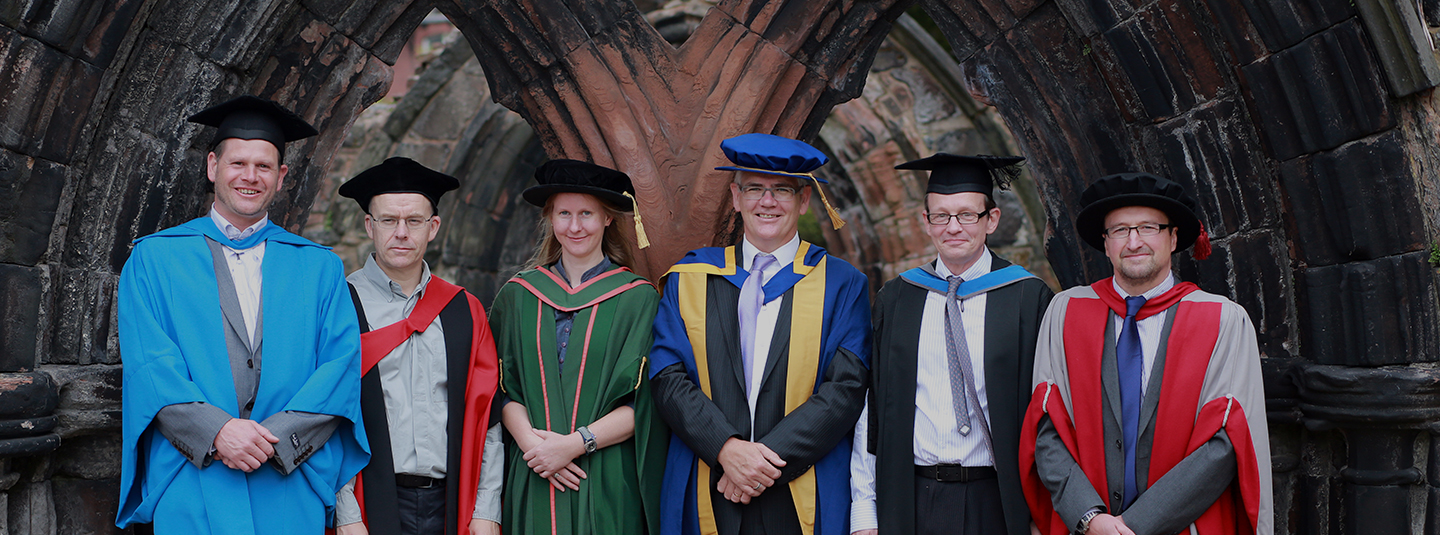
Honorary fellows: 2013
Honorary fellowships were conferred on the following people in the July and November ceremonies of 2013.
July ceremonies
Anne Attwood
In recognition of her outstanding contribution to further and higher education in Cumbria.
Anne trained as a primary school teacher, but worked for twelve years in secondary schools in Widnes and Middlesbrough. With a passion for promoting drama in the classroom and theatre on stage, she moved to the North East in 1980 to be head of drama in an 11-16 secondary school followed by a move to Stockton & Billingham Technical College.
Her leadership skills quickly developed and she became Executive Director at Furness College in 2001 and then Principal in 2003, helping to improve the Colleges OFSTED results, acquire funding for a new campus and academy, and to develop partnerships with the University of Cumbria, dramatically enhancing the FE provision in Barrow and the surrounding area. Anne retired from Furness College in 2015 but still loves living in Cumbria.
Lord Dale Campbell-Savours
In recognition of his support to higher education in Cumbria and his outstanding contribution to the economy of West Cumbria. (awarded July 2013)
Born in 1943, Dale Campbell-Savours was educated at the Keswick Grammar School and at The Sorbonne in Paris, spending his formative years hitchhiking through Europe and the Middle East. On his return, he set up a clock manufacturing company in Lancashire. His clocks sold worldwide under the trading name of Xavier of London and are still available today.
He joined the Labour Party in 1965 and was elected to Ramsbottom Urban District Council. In 1976, he sold his manufacturing company, moved to Workington and elected MP for the town in 1979, holding the seat for 21 years until his retirement following a long period of ill health.
He was created Lord Campbell-Savours of Allerdale in 2001. Dale held several shadow ministerial responsibilities in the 1990s including portfolios for overseas development and agriculture. He gave evidence to the Nolan commission on standards in public life with many of his recommendations being implemented.
In 1986 he began a campaign challenging the operations of the official Secrets Act. He was a former member of the Security and Intelligence committee monitoring MI5, MI6 and GCHQ. In 1991, he proposed the Supplementary Vote a new electoral system subsequently adopted by government in 1999. In 1993, he proposed the introduction of a national cattle identity scheme which was subsequently established in Workington under British Cattle Movement Service in 1998. In 1995 he proposed a “University of the Lakes” leading to a government working party and the eventual establishment of the University of Cumbria in 2007.
Nigel Couzens
In recognition of his outstanding contribution to the Energy Coast Campus. (awarded July 2013)
Nigel was born in Bristol and joined the Royal Navy, completing a Commission as an Officer in the Submarine Service. Whilst on duty, he met his wife in Workington, and moved to the town and started his family. Since residing in the county, he has worked at Sellafield Ltd, Cumbria Training and Enterprise Council, Cumbria Learning and Skills Council, the Nuclear Decommissioning Authority and Energus, where he was the Executive Director. In partnership with the University of Cumbria, GENII, Lakes College, Sellafield Ltd and the University of Manchester, Energus became a Centre of Excellence with a focus on training, education and research capacity and capability for the energy sector.
Having recently spent a period of time with Babcock International Group as their Head of Nuclear Skills and Learning he led the operation and development of training within a number of major Nuclear sector employers across the UK and abroad. He returned to Cumbria at the end of 2018 to join the Civil Nuclear Constabulary (CNC) within the Human Resources team. Based in West Cumbria Nigel supports the Northern Division of the CNC and is working with the University of Cumbria to develop employer led armed policing initiatives and programmes.
Jeff Cowton MBE
In recognition of his lifelong service to the Wordsworth Trust and his outstanding contribution to the wider museum sector. (awarded July 2013)
Jeff Cowton was born in Alnwick in 1959 and graduated with a degree in Modern History from the University of Leeds in 1980, taking up a temporary post as a guide at Wordsworth’s Dove Cottage in Grasmere a year later. In 1983 he was appointed Librarian, later becoming Principal Curator and Head of Learning leading the Trust’s Curatorial and Learning Team. In 2025 he moved to a consultancy role and began study for a PhD with Northumbria University on the Newcastle engraving workshop of Ralph Beilby and Thomas Bewick.
In his time at the Trust, Jeff led the development and management of the Trust’s ‘Designated Collection’ of manuscripts, books and fine art. In 2005, he oversaw the move of the collection into the Jerwood Centre, a state-of-the-art storage and research facility. More recently, he led the reinterpretation of the displays in the museum and Dove Cottage as part of 'Reimagining Wordsworth', opening as ‘Wordsworth Grasmere’ in 2021. Outside of Grasmere, Jeff led initiatives into community-based work (especially programmes designed for people with extra needs) and developed a strong network with universities worldwide. Over the last 30 years Jeff developed a training programme which has seen hundreds of young people gain their first experience of museum work, and which included the delivery of the first cultural apprenticeship scheme in museums.
Malcolm Wilson OBE
In recognition of his outstanding contribution to the motorsport industry and business in the Cumbrian community. (awarded July 2013)
Malcolm Wilson was born in 1956 and attended Cockermouth School before joining the family business selling motor vehicle parts. Inspired by the British rally driver, the late Roger Clark, Malcolm pursued a career in the motorsport industry from an early age and has almost 40 years’ experience of rallying at World Championship level. As a driver, he won two British national titles in the late 1970’s and achieved a long-held ambition by winning the British International crown in 1994.
Malcolm Wilson Motorsport Limited was founded in 1979 and changed its name to M-Sport in 1996 when the company was awarded the Ford contract for rallying and for research and development. The team under Malcolm’s leadership has enjoyed much success, including lifting the WRC Manufacturers’ trophy two years in succession in 2006 and 2007, the WRC Manufacturers’ and Drivers’ titles in 2017 and the WRC Drivers’ Championship trophy again in 2018.
In its mission to be a world leader in rallying, M-Sport also operates a thriving customer support business for private teams. Assisting Ford drivers with motorsport programmes around the world and establishing a true Ladder of Opportunity, they are the only manufacturer to offer a car across all levels of the FIA Rally Pyramid and the biggest manufacturer of Ford racing vehicles in the world.
In 2013 the company caught the eye of Bentley Motors and embarked on a new venture on the racetrack – selected to spearhead the design and development of the luxury manufacturer’s Continental GT3. Completing the first car in just six months, the Continental GT3 went on to secure considerable success and became the car of choice for several works-supported teams around the globe.
In 2018, M-Sport also entered the world of electric motorsport as Jaguar’s technical partner in the I PACE eTROPHY. Running alongside the FIA Formula E Championship, the zero-emission series completed two seasons and was M-Sport’s first step into sustainable motorsport – a concept further developed with the introduction of hybrid technology in the 2022 FIA World Rally Championship and TOCA BTCC engine.
As well as its main Dovenby Hall operations on the edge of the UNESCO English Lake District National Park, M Sport has expanded to include a European base with a state-of-the-art facility in Krakow, Poland – where lays responsibility for all two-wheel-drive activities.
The UK base has also grown with the development of the M-Sport Evaluation Centre. The multi-million-pound facility includes a 2.5-kilometre test track and provides a unique centre of engineering excellence where leaders in automotive technology can follow concepts from design to production on one exclusively situated and expertly equipped site.