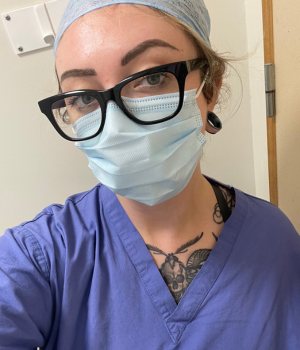
Kes Sinfield-Newman
BSc Hons Radiography (Top up) (Apprenticeship)

BSc Hons Radiography (Top up) (Apprenticeship)
Kes is an apprentice radiographer whose journey shows how an apprenticeship can open the door to a new career. After starting out in healthcare at 18, she discovered a passion for radiography and used the apprenticeship route to build her skills and confidence.
I have been working in healthcare since I was 18 years old and have always felt very passionate about it. I started off as a care assistant but felt like I could be doing more. One day, I saw an advert for a Clinical Assistant role in MRI and applied. As soon as I began working in radiography, I absolutely fell in love with it. I admired everything my radiographer colleagues were doing and kept thinking, one day this will be me.
I had actually attempted university before but unfortunately had to leave due to family circumstances. I wasn’t sure if I would ever be in a position to try again, but the apprenticeship gave me that chance. When the opportunity became available through work, it felt like a perfect match — a way to progress my career, make something of myself, and continue helping people, all while maintaining the life I had already built with my husband.
I’ve developed a much deeper respect for the work we do as radiographers and the difference we make every day. I love being able to walk patients through their scans with genuine expertise, which helps provide the high‑quality care they deserve. My scanning skills have progressed massively — I’m now confidently tackling the same complex cases I used to watch my colleagues handle in awe.
While I always knew that patient care was one of my strengths, I really wanted to develop my clinical knowledge. The apprenticeship has given me exactly that opportunity, helping me grow both technically and professionally in ways that directly improve the care I provide.
The apprenticeship has been a catalyst for immense personal growth, particularly in my self‑confidence. As an autistic individual, social interactions have often been challenging for me, but the structured environment of the programme — along with the incredible support from my lecturer and peers — encouraged me to face those challenges head‑on. This has strengthened my communication in clinical practice and transformed my confidence in my personal life. I’m incredibly grateful for a journey that has allowed me to grow both professionally and personally.
I have changed how I interact within the clinical environment. While social interactions were once a hurdle for me, I now proactively engage with both patients and the wider multidisciplinary team. I’ve developed a structured way of explaining procedures that helps patients feel safe, informed, and heard.
I also now have a deeper understanding of radiographic theory, which I can apply directly to my practical scanning. I no longer hesitate when faced with technical challenges — instead, I use my improved knowledge to troubleshoot confidently. I’m also performing more complex scans and contributing more effectively to the team’s overall throughput.
The research poster module was the real turning point for me. Hearing that our work could potentially be featured at UKIO 2026 transformed what felt like a standard assignment into a genuine mission. It sparked a determination in me, because for the first time I felt that my idea could actually influence change within healthcare.
During the process, I reached out to the Dyslexia Association, which led to an invitation to attend the Dyslexia Conference to discuss my research. That experience solidified my commitment to this cause. I am now a dedicated campaigner for these changes and am thrilled to be presenting my research at UKIO 2026 — proving that with enough passion, academic projects can genuinely make a difference.
If there is one thing this journey has taught me, it’s that the boundaries of radiography extend far beyond the imaging room. This profession opens doors to leadership, research, and advocacy that I never previously imagined. We aren’t just doing a job — we are representing the future of healthcare.
As Dr. Seuss so perfectly put it, “unless someone like you cares a whole lot, it’s not going to get better, it’s simply not.” This course has helped me understand that if we want to see change in our hospitals and for our patients, we have to be the ones who care enough to start it.
I cannot thank the University enough for the support I’ve received. They truly understood my needs, allowing me to use sensory rooms during exams so I could perform at my best without becoming overwhelmed. What stood out the most, however, was the mentorship. My lecturers never dismissed my ideas — they listened, guided me, and cheered me on from the sidelines as those ideas developed into real‑world projects.
I feel incredibly lucky to have had such a dedicated team of academic staff supporting me every step of the way.
If this opportunity comes your way, embrace it with everything you have. There will undoubtedly be challenges and moments of hardship, but a smooth sea never made a skilled sailor. Every hurdle is simply part of the process that shapes you into a stronger practitioner.
Throw yourself into every step of the journey. When you finally walk away with your degree, you won’t just have a qualification — you’ll have the pride of knowing you took a leap of faith that transformed your future.
.webp)