

After her undergraduate degree, Ligia realised healthcare needed to be about people, not just conditions. That realisation led her to study Occupational Therapy at the University of Cumbria, where hands-on placements, a close-knit community, and life as an international student have shaped her journey. Read Ligia's story below to see how studying at the University of Cumbria has helped shape her interests, and why she’s never looked back.
Why did you choose to study your course – what or who inspired you?
Healthcare has always been my intended path, but after completing my undergraduate degree, I began to feel that a diagnosis alone often overlooks key aspects of a person’s life, including their environment, lived experience, and the meaningful activities that shape their identity. I found myself wanting a practice that was truly patient centred rather than solely condition focused.
I chose to pursue Occupational Therapy because I believe it addresses those gaps through its holistic approach to care. I wanted to move beyond one-size-fits-all models and instead provide tailored, functional support that fosters confidence, independence, and meaningful participation, regardless of diagnosis.
Why did you choose the University of Cumbria?
I chose the University of Cumbria because I felt assured from the very beginning that I would be well supported academically and personally.
Pursuing a postgraduate degree overseas is a significant step, and the clarity, warmth, and efficiency in communication stood out to me. It showed me that the university values its students beyond just admissions. That sense of support has remained consistent throughout my course, and it has allowed me to settle into the programme smoothly.
What has been your favourite experience at Cumbria?
What I’ve enjoyed most at the University of Cumbria is the strong sense of community, both in and outside the classroom. My cohort is incredibly supportive and collaborative, which makes learning practical and enjoyable.
The trips to the Lake District have been a highlight as well, combining rest in between academics and opportunities to explore parts of the country.
How have you found your placement? Where was your placement, and what was it like?
My first placement was an incredible opportunity to work in a paediatric service with a supportive and inspiring team. Commuting to Kendal had its challenges, but the hands-on learning and direct interaction with children made every trip fulfilling.
I gained valuable experience applying Occupational Therapy principles in real-world settings, from supporting children’s daily activities to collaborating with families and other professionals. By the end of my placement, I felt more confident in my skills and motivated to continue developing as an Occupational Therapist.
If you’re an international student: how have you found studying at Cumbria as an international student?
Studying at the University of Cumbria as an international student has been a very positive experience. I’ve felt supported by staff and welcomed by my cohort, which has made adapting to life and studies in the UK much easier.
The university provides excellent resources, such as Skills@Cumbria, where I can check portions of my work before submitting them. Being able to see how I can improve and learn as I go has allowed me to develop my skills in a balanced and structured way, building both my confidence and independence as a student.
What’s been the most difficult obstacle you’ve overcome in your student journey?
Managing long commutes during the icy winter months was a significant challenge, as train delays and cancellations were common. As an international student who was less familiar with the area, navigating these journeys felt particularly daunting.
This experience taught me patience, adaptability, and the importance of preparation, and overcoming this challenge has made me more confident in managing the practical demands of my studies and placements.
What do you enjoy most about your course?
What I enjoy most about my course is discovering that I am truly a people person. Years of studying diagnoses, seeing their manifestations, and how people live with them showed me just how unique each individual’s experience is. While I have always been interested in science, spending four years in a lab doing repetitive tasks made me realise I thrive when I can work directly with people.
I love seeing the impact of small changes we make in someone’s life, whether it’s helping a child gain independence or supporting someone to use equipment like a wheelchair to improve mobility. Occupational therapy interventions feel meaningful and often lifelong, making all the learning and effort feel incredibly worthwhile.
How have your tutors supported you during your studies?
My tutor has been very supportive throughout my studies, keeping tabs on my progress while giving me the space to work independently. I especially appreciated how she reached out at the beginning of the course to check how I was adjusting, which made the transition much easier.
Coming from a large university where I rarely had the chance to speak to professors personally, having this level of guidance and personal connection has been really positive.
How is university life beyond your studies?
Life at university beyond my studies has been enjoyable and much more balanced.
What do you enjoy the most about student life at your campus/in the area?
I enjoy how close-knit and welcoming both the University of Cumbria and Carlisle feel. Having 24-hour access to the Learning Gateway is great for studying safely at any time, and living with supportive flatmates makes life even better. There’s always something happening in the city to enjoy.
What would be your top tips for people thinking of doing the same course as you?
If you’re considering Occupational Therapy, take the leap. The course keeps you engaged with hands-on learning, placements, and opportunities to see real changes in people’s lives. You will never be bored (in the best way possible).
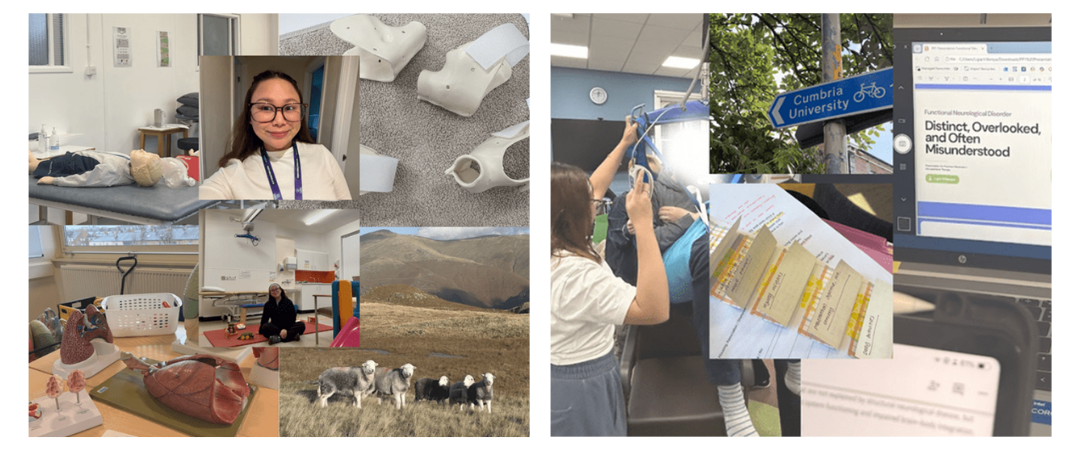
As for those who are currently on the course, whether BSc or MSc, whenever you’re feeling overwhelmed you can always join chaplaincy trips to the Lake District — staring at sheep is surprisingly therapeutic.
What are your career plans, and how is your course preparing you for your future career?
At the moment, I’m most drawn to paediatric Occupational Therapy, though I’m open to seeing how future placements might shape my interests. I know I still have a long way to go, so I’m just excited to see how I can grow and contribute in the field of OT.