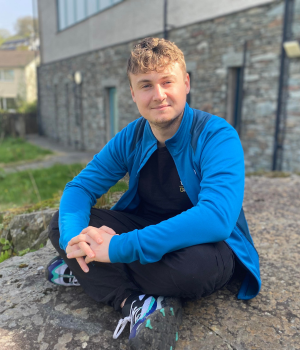
Dr Jack Richard Brennand
PhD in Geography

PhD in Geography
Jack’s route into studying his PhD was far from conventional, but it became one of the most rewarding chapters of his life. Although he never pictured himself doing a PhD, the experience quickly became something he loved — a chance to explore ideas freely, follow curiosity, and build skills that made him far more employable.
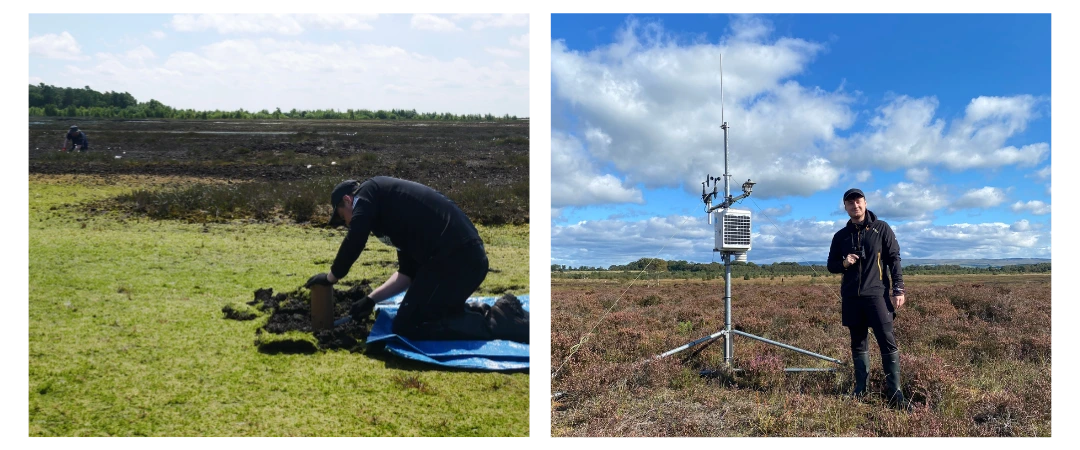
I was part of the ECO-I North West project, working with a local SME who specialise in peatland restoration. My thesis focused on evaluating how effective different peatland restoration techniques are. That ranged from looking at the micro‑scale environmental impacts of various methods, right through to assessing the carbon costs of implementing them - essentially, what the carbon footprint behind each technique looks like. Overall, I aimed to build a better understanding of how peatland landscapes function after restoration has taken place.
I think the spark for my research really came from the first time I learned about peatlands. I remember being struck by the fact that they’re the largest terrestrial store of carbon on the planet - and then equally shocked to learn that around 97% of England’s peatlands are in a degraded or poor condition. That means they’re actually emitting more carbon than they’re storing.
That idea stuck with me. It felt like a huge opportunity to work in a field that could have a genuinely positive impact on the climate. So that became the main driver behind my research.
I’ll admit I was also heavily influenced by growing up watching David Attenborough and programmes like Countryfile. But really, it was the potential I saw in peatland restoration as a nature‑based solution to the climate and biodiversity crises that pulled me in and kept me motivated.
From an early age, I always wanted to be a marine biologist because I was obsessed with the sea - watching things like Blue Planet and anything nature‑related. I always knew I wanted to work in the natural world in some way, whether that was protection, conservation or restoration.
I started my undergraduate degree at another university, but I was disappointed that in a whole year we only went out in the field four times to actually do geography. So I transferred to the University of Cumbria to finish my degree in Geography - and that’s where I met Professor Simon Carr.
I was never much of an academic. I’m dyslexic, I struggled at school, and I always assumed I’d go straight into practical ecology work. Honestly, if it wasn’t for my fiancée and my mum, I probably wouldn’t have gone to university at all. But Simon was one of those figureheads who really saw potential in me. He recognised how practical I was, and he saw my dyslexia as a strength - a different way of thinking that brought something new to the table. He mentored me, supported me, and really took me under his wing.
When the PhD opportunity came up, he encouraged me to apply and guided me through the process. He ended up being my lead supervisor, too. Without that support, I don’t think I’d ever have imagined myself doing a PhD.
Simon was wonderful in that he always treated me as a colleague rather than just a student, which made me feel genuinely valued. Over time he became more of a friend, and we’re still friends now, even after the PhD journey has finished.
It’s hard to describe what a PhD is like, because your supervisor sees you at your absolute lowest points and when you’re riding the highs. Simon was brilliant at grounding me when I needed grounding and lifting me up when things were tough. He struck that balance well - being professional when he needed to be, but also being a shoulder to lean on when that was what the moment called for.
I also had a huge amount of support from the SME I worked with. Professor Jane Barker, who was my secondary supervisor and the Managing Director of Barker and Bland, was incredible. The company supported my PhD financially and gave me access to sites, materials and expertise. Jane helped me academically and personally, and her guidance was a big part of getting me through.
On the university side, we had a small but supportive PhD community on the Ambleside campus. I was the ambassador for the PhD students there, and we built a close‑knit group that looked out for each other. At one point, one of our colleagues became pregnant and there wasn’t a clear policy for how maternity leave would work for a PhD student, so we all came together to figure it out. It was that kind of personal, peer‑to‑peer support that made a big difference.
Academically, we didn’t have a peatlands research group at the University of Cumbria at the time (there’s one coming soon!), but we did run sessions where we shared pieces of writing and talked through how each of us approached things. It was always positive - more about learning from each other than critiquing - and that was helpful, especially because we were all working on quite niche topics.
Funding works differently depending on the project, but there are usually a few common routes. Most PhDs are funded for three years by a research council, and then there’s often a kind of “grey area” year where you’re not funded.
In my case, I was funded for three and a half years through the ECO-I North West project. I was sponsored by an SME, who match‑funded part of the research council’s support, and the overall funding came through the European Regional Development Fund.
I tried to put money aside each month because I knew there was a chance I wouldn’t finish exactly on time, but in the end I just couldn’t make it stretch far enough. When my funding ended, I still needed a few months to finish writing up. Without my fiancée, I honestly don’t know how I would have managed. She supported me financially, and she took on everything at home - including looking after our dog - while I was working 15–16 hour days towards the end. That support was absolutely crucial.
If I hadn’t had her, the realistic option would have been to drop down to part‑time and work three days a week, then do the PhD on the remaining days and weekends. That’s a completely valid route for a lot of people.
From my experience, the funding definitely covered enough time to complete all of my research. It was just the final write‑up that was tough - partly because, as someone who’s dyslexic, writing takes me a bit longer, and partly because I’m a perfectionist. But that hard work paid off: I passed my viva with no corrections. There’s a world where I could have submitted earlier, but I’d likely have ended up doing corrections while working full‑time in my current post at the University of Manchester, which would have been even harder.
I do think the system is tough, and with the rising cost of living it’s getting harder. There’s often an expectation that you’ll have to sacrifice something - time, income, or work‑life balance - to get your thesis in on time. I was lucky to have support around me, but not everyone has that, and it’s important to acknowledge how challenging that final stretch can be.
My viva was essentially an examination of my research, and the aim is to show three things: that you know your work inside out, that the research is genuinely your own, and that you’ve thought about the bigger picture of where it leads. You’re examined by an external examiner - someone you won’t know personally but who’s an expert in your field - and an internal examiner from the University of Cumbria who has relevant knowledge but isn’t someone you work closely with. There’s also a chair, whose job is to keep things fair, help the conversation flow, and calm your nerves at the start. Mine were all wonderful, and they made me feel comfortable right away.
Preparing for the viva is a strange experience, because how do you revise something you’ve spent years writing? It’s your book - you already know it. The only real preparation I did was reading through my thesis again. I kept a Word document open where I noted down any areas that felt a bit weaker or where I hadn’t explained something as clearly as I could have. I also flagged any spelling or grammar mistakes, because once your thesis is printed and bound, you want it to be as close to perfect as possible. Reading it with that mindset helped me refresh the details and think through how I’d explain certain decisions.
My viva lasted about two and a half hours. You can usually tell early on whether your examiners are happy with your work. In my case, they were - and I realised that when we moved quite quickly into big‑picture questions rather than nitpicking individual paragraphs or studies. When they started asking things like, “You’ve said the purpose is this - how would you actually take that forward?”, I felt much more confident.
But every viva is different. It’s one of those things you can’t fully understand until you’ve done it. It’s not like any revision you’ve done before, and it’s not a memory test - you’ve lived and breathed this research for years, so it’s already in your head. A PhD becomes a lifestyle.
The best advice I can give is to take your time. I paused a few times to gather my thoughts, and that’s completely fine. Get a good night’s sleep beforehand, and don’t expect any training course to prepare you perfectly - it’s too individual for that. Tips and guidance are helpful, but ultimately you just have to go through it yourself.
The application process felt a lot like a job interview, and that’s exactly how I approached it. The University of Cumbria was looking for a PhD candidate to carry out research funded through the ECO-I North West project I already knew about the project from being at the university, and the opportunity was advertised on a site like Find a PhD, so I applied in the same way anyone else would.
Even though I was already at Cumbria, I still had to apply externally and go through the same process as everyone else. I went in with huge imposter syndrome because I hadn’t done a master’s - I’d gone straight from my first‑class undergraduate degree - and afterwards the panel told me there were applicants with ten years’ experience at the Environment Agency and two master’s degrees. But the difference with a PhD interview is that the panel isn’t just looking for the most qualified person on paper. They’re looking for someone they want to work with very closely for four years and beyond.
A PhD isn’t the end point - it’s the start of the research. Supervisors want someone who has drive, motivation and the willingness to learn new skills. No one ever ticks every box, because PhDs are so niche and tailored. You’re always going to have to learn something new.
The interview itself was a mix of “what would you do if…” questions and tasks based on the skills you already have. It felt like a job interview, just more specific to research.
I always tried to be vocal about my research throughout my PhD, and that opened a huge number of opportunities. I went to a lot of conferences - both national and international - and that made a massive difference. I presented at the EGU General Assembly in Vienna, which was enormous, around 30,000 people. I also presented at the British Ecological Society conference in Edinburgh, and at IUCN events in Wales. I did posters, talks, the lot.
Because of that visibility, people started keeping an eye on my work and waiting for me to finish. As soon as I submitted, things took off. I’m now leading a DEFRA evidence review with the IUCN, which is incredible. I’m also collaborating with the University of Exeter on a project that takes my PhD data and looks at it through an economist’s lens - essentially asking, “You’ve shown which techniques are effective, but what do they cost, and what’s the cost–benefit of each?”
There are collaborations with researchers from Edinburgh University and Southampton University, especially around the methodological side of my research—how you take huge landscapes and condense them into representative study areas. That work has even fed into discussions with the Scottish Government about a potential land carbon tax for degraded land, and my research is helping inform how you’d monitor and assess something like that fairly.
I also ended up with a postdoc at the University of Manchester before I’d even submitted my thesis - they basically poached me early and said, “It’s fine, you can finish writing up once you start with us.” So the past six months have been absolute chaos in the best way.
Teaching at the University of Cumbria also helped me develop a lot of transferable skills. I did quite a bit of teaching, which not only built my confidence but also helped fill funding gaps - not all universities pay for extra teaching, so that was a real bonus. And because I’d done so many talks and presentations, I felt much more prepared for the opportunities that came later.
Even my viva led to new opportunities. My external examiner was so happy with how it went that they invited me to co‑author a paper and get involved in a research project afterwards.
I’d say doing a PhD has been one of the best experiences of my life. I absolutely loved the first three years - it felt like the most wonderful job. You have the freedom to follow ideas, disappear down rabbit holes, learn completely new things and really upskill. I became so much more employable because of the skills I gained.
There’s a slightly scary statistic that around two‑thirds of PhD students don’t make it to the end, and I think part of that is because after two years you’ve learned so much that you suddenly are employable. People start dangling opportunities in front of you, and it’s tempting. You also become more confident in your own thinking, and that can open doors.
But you have to be genuinely interested in your topic. If you’re even slightly indifferent, when things get tough - and they will - you just won’t push through. Curiosity is the thing that carries you through the hard bits.