
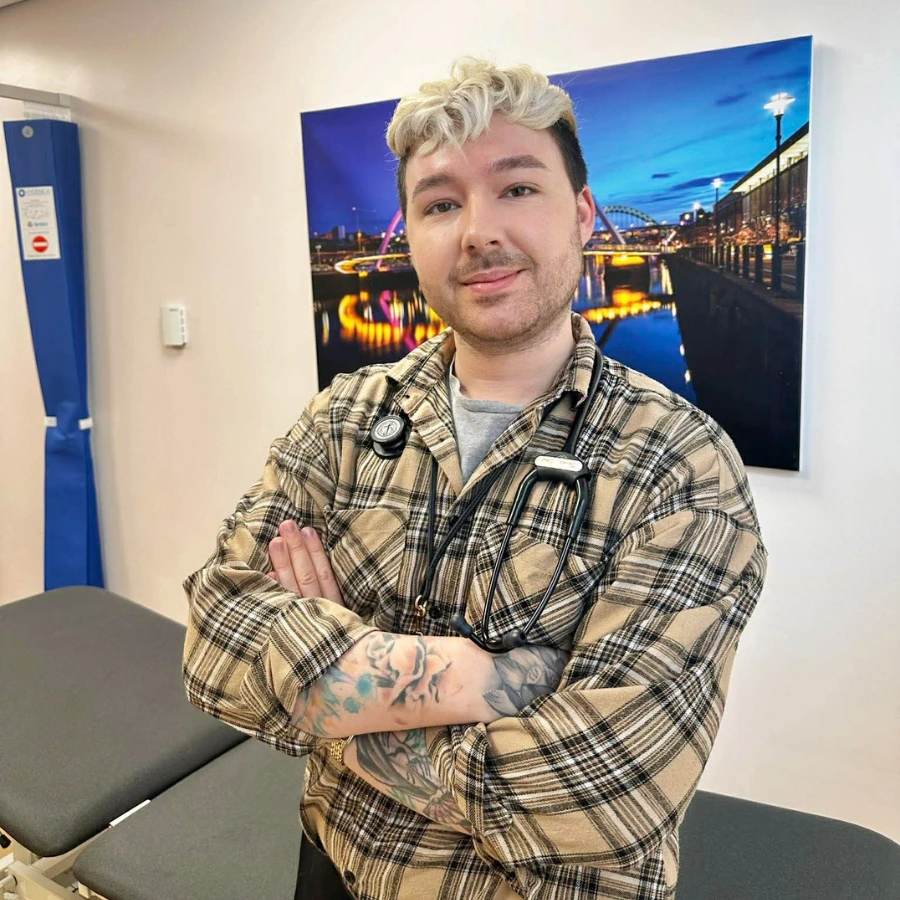
James started his career in cardiac intensive care, where he saw just how transformative Advanced Clinical Practitioners could be. Their depth of knowledge, confidence, and impact on patient care lit the spark that set him on this path. Now training as an Advanced Clinical Practitioner (ACP) in General Practice, he’s surrounded by GPs whose skill, dedication, and passion push him to grow every single day.
What motivated you to pursue postgraduate study, and why did you choose your specific course?
I have always known that I wanted to pursue postgraduate study. As a nurse, you commit yourself to continuous learning and development, and this has always been important to me. I began by completing a few postgraduate CPD courses, but I knew I ultimately wanted to complete a master’s degree.
When I was a student, I became aware of the role of an Advanced Clinical Practitioner and immediately knew that it was the job I wanted to work towards. The more I learned about the course, the more determined I became to pursue it. I was particularly drawn to Advanced Clinical Practice because it allows you to develop autonomous clinical skills and progress your career as a clinician while remaining patient‑facing, which has always been essential to me.
Was there a particular experience, professional goal, or person who influenced your decision to continue your studies at postgraduate level?
I began my career in cardiac intensive care and saw firsthand the impact that Advanced Clinical Practitioners had. Their knowledge and expertise were incredible, and that was what originally influenced me to pursue this career path. Now, working in general practice as a trainee Advanced Clinical Practitioner, I am inspired every day by the GPs I work alongside. Their depth of knowledge, clinical skill, and dedication to patients’ care is amazing. They work incredibly hard, are committed to supporting their patients, and their passion for General Practice is truly inspiring. They push me, encourage me, and support me to develop my own practice every single day.
What factors led you to choose the University of Cumbria for your postgraduate studies?
One of the biggest factors for me is definitely the flexibility of the course, and the ability to study through distance learning. Being able to study around a full-time job certainly takes some of the pressure off. Having the flexibility to work in your own time means you can go at your own pace and study when it’s convenient. For me, being able to pause, look things up, or explore topics in more detail really helps me memorise information, and I feel like I’m developing my knowledge as I move through the material.
The modules run one after the other, which is great because it means you only need to focus on one module at a time. The course is structured in a very clear and organised way, which is so important for distance learning, and the level of support is great.
In what ways has your postgraduate experience at the University of Cumbria aligned with or differed from your expectations?
A postgraduate master's course like this requires a lot of learning outside of the lectures. There is an expectation to complete further reading and research around the topics covered at university. There is also a responsibility to learn about medical conditions in much greater depth to develop an understanding of the presentations that you may see in day-to-day practice, and therefore how best to treat them.
One aspect that differed from my expectations was the level of support available through remote study. You might assume that studying at a distance means you won’t receive the same support as face‑to‑face learning, but the team on the Advanced Practice course are fantastic. When I first enquired about the course, the team responded promptly and guided me through the application process, which made everything run smoothly.
My academic tutor has been fantastic in supporting both my studies and progress. The weekly tasks help keep you on track and guide you towards the content you need to start exploring and reading around. However, there is an expectation at this level that you take responsibility for your own learning and engage independently with the material.
What has been the most rewarding or memorable aspect of your postgraduate journey so far?
The most memorable moment so far has been the first day of the course. It felt incredibly exciting to be given this opportunity and to begin this journey, and although it feels like it only happened yesterday, the time has absolutely flown by.
Another standout moment was having all my clinical examinations signed off by my mentor. It was a great feeling to know that he has trust and confidence in my ability to competently examine patients with multiple co‑morbidities. Equally, being told by patients that their experience has been a positive one is incredibly rewarding. Knowing that you have potentially made a difference to someone’s care is one of the most fulfilling parts of the journey.
How has postgraduate study pushed you academically, professionally, or personally?
I found that many elements of the course translate directly into everyday practice, and vice versa. Academically, it pushes you to work to a high standard of writing, critical thinking, and research. Professionally, it equips you with the tools and a strong foundation to work confidently within the role. It is certainly challenging, but it is absolutely worth it.
Have you undertaken placements, consultancy projects, volunteering, or part‑time work alongside your studies? How has this supported your professional growth?
I think the course and the exposure I gain from being in a trainee ACP role go hand in hand in developing me both clinically and academically across the four pillars of advanced practice. You certainly need that exposure and mentorship from your clinical mentor to be able to tailor your learning experience.
How has your course helped you build new skills, networks, or career pathways?
The course is designed so that senior clinicians act as your mentors, which naturally helps you build strong relationships with professionals at the top of their field. This allows you to build networks with other professionals to assist in learning and experiences that will develop your own clinical journey.
In terms of skills, the Objective Structured Clinical Examinations (OSCEs) and practical elements of the course allow you to learn and develop in a way that enables you to examine patients to a medical standard. This provides a solid starting point for forming diagnoses and strengthens your confidence in clinical assessment and decision‑making.
From a career perspective, completing postgraduate study and gaining this qualification places you in a recognised senior clinical position. Because the course develops you across all four pillars of advanced practice – clinical practice, education, leadership, and research – it opens up a wide range of senior career pathways.
What advice would you give to someone considering postgraduate study at the University of Cumbria?
Don’t hesitate! Reach out to the course leaders for help and advice, as they are the best people to put you on the right path. Take every opportunity to learn and grow from experiences. There’s no better investment for your career than investing in yourself.
What are your plans after completing your postgraduate degree, and how is the University of Cumbria helping you work towards those goals?
My plan is to continue in my role as an Advanced Clinical Practitioner in General Practice and really put my skills and knowledge into practice. I have a particular interest in cardiology and have previously run my own cardiology clinic, assessing ECGs, taking a history, and examining patients to provide diagnoses, so I would love to expand on this.
I’m also keen to continue developing professionally and would consider a PHD, further training, or even lecturing on a course like this master’s to help others achieve their goals. Completing this master’s with the University of Cumbria will open so many opportunities within healthcare, whether in clinical practice, education, research, or leadership. I cannot emphasise enough how grateful I am to be part of this course and to be guided by expert leaders both within the university and in General Practice.