{"available": "entirely", "availability": {"status": {"Recruiting Status 26/27":"RP 26/27","Recruiting Status 27/28":"RP 27/28","Recruiting Status 25/26":"RP 25/26"}, "dates": [{"name":"September 2026","month":"September","year":2026},{"name":"September 2027","month":"September","year":2027},{"name":"September 2025","month":"September","year":2025}]}}
BSc (Hons)
-
Midwifery Degree Apprenticeship
The BSc (Hons) Midwifery Apprenticeship offers an exciting opportunity for healthcare assistants or maternity support workers employed by the NHS to train as qualified midwives through a degree apprenticeship programme, supported by their employer NHS Trust. This programme is designed to develop competent and compassionate registered midwives with up-to-date knowledge of maternity care, enabling them to confidently lead and coordinate the care of women, birthing people, and their families. Throughout the apprenticeship, apprentices receive close guidance and support, ensuring they are fully prepared to step into professional midwifery roles upon completion and make a meaningful impact in maternity services.
Develop into a critical‑thinking and effective practitioner with the skills, knowledge and understanding required to become a graduate midwife registered with the Nursing and Midwifery Council.
Equip you with the knowledge, skills and behaviours to meet the Midwifery Degree Apprentice Occupational Standard.
Practise as a reflective, accountable and autonomous midwife capable of adapting to the changing nature and context of midwifery practice.
Provide safe, compassionate and evidence‑informed care for all women, birthing people and newborn infants, including those with additional care needs, across a range of settings.
Demonstrate effective professional relationships through respectful, compassionate communication and collaboration with colleagues, women, birthing people and their families.
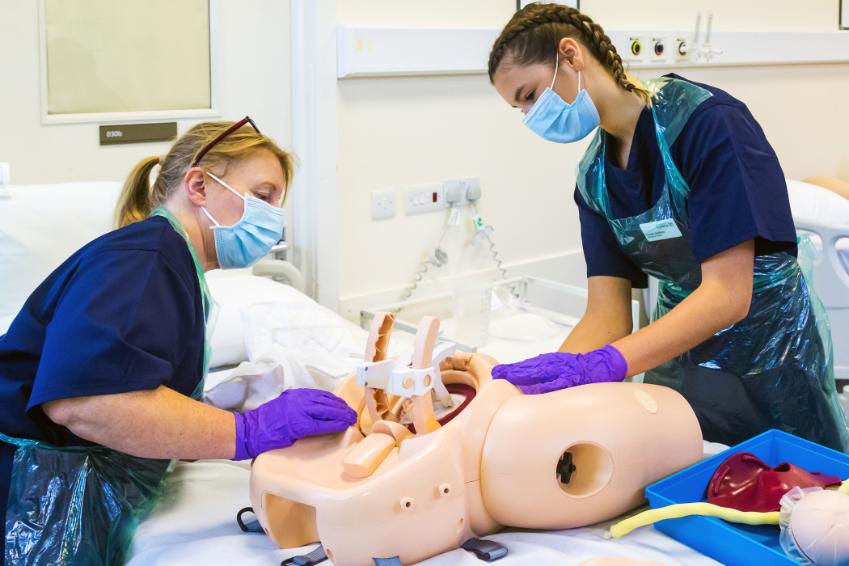
In Year 1, apprentices are introduced to the foundational knowledge and skills required for midwifery practice, including anatomy and physiology, professional values, effective communication, and safe, evidence-based care. Apprentices begin developing clinical skills and participate in supervised practice placements, applying theoretical learning in real-world maternity care settings.
Year 2 builds focuses on more advanced midwifery practice, including holistic assessment, care for women with complex needs, pharmacology, leadership in maternity services, and reflective practice. Apprentices continue to consolidate clinical competence through placements across a range of settings, gaining autonomy while adhering to professional standard.
In Year 3, the programme emphasises integration and professional readiness, enabling apprentices to lead and coordinate the care of women, birthing people, and their families, applying advanced decision-making, leadership, and evidence-based practice. Completion of this year prepares apprentices for registration with the Nursing and Midwifery Council and confident transition into fully qualified midwifery roles.
How you will learn
Fifty percent of the programme time is taken up with theoretical elements, which include tutor-led classroom learning and online learning via the Virtual Learning Environment (Blackboard). Fifty percent of the time is spent in clinical placements, in the Employer Partner Trust.
How you will be assessed
There is a range of assessment methods on the programme to facilitate different learning styles and skills, and to represent the skills required of a qualified midwife. Methods include written assignments, exams, professional discussion, presentation, and OSCE.
Selection criteria
GCSE in English Language, Mathematics and Biology (or Combined Science) at grade C or above. Level 2 Functional Skills in Maths and English will also be accepted.
120 - 128 UCAS tariff points. You can find out more about the tariff and qualification options from the UCAS tariff table. Offers are tailored to the individual applicant and their circumstances and can be across the tariff range but may include:
A-levels BBB – ABB preferably to include Biology or PE
T-levels - All T-levels are accepted however Healthcare Science and Health are recommended.
Level 3 BTEC Extended Diploma DDM - units in Sexual Health; Reproduction and Early Development Stages preferred.
OCR Cambridge Technical Level 3 Extended Diploma in Health & Social Care DDM – units in Sexual Health; Reproduction and Early Development Stages preferred.
Access to HE Diploma with 60 credits overall. 30 Credits at Distinction and 15 at Merit to preferably include 21 credits in Biology or Human Physiology.
Scottish Highers AABB - AAAB preferably to include Biology
Irish Leaving Certificate Highers A2x4 – A1, A2x3 preferably to include Biology
Employer selection criteria
Entry requirements to the apprenticeship are set locally by individual employers. Apprentices will also need to meet the entry requirements set by the University and the NMC.
Nursing and Midwifery Council Requirements:
The NMC (2019) stipulate that Approved Education Institution (AEIs) together with practice learning partners must ensure selection, admission and progression comply with the NMC standards framework for nursing and midwifery education and confirm on entry to the programme that students:
Enrolled on pre-registration midwifery programmes are compliant with Article 40(2) of Directive 2005/36/EC regarding general education length or nursing qualification
Demonstrate an understanding of the role and scope of practice of the midwife
Demonstrate values in accordance with the Nursing and Midwifery Council (NMC) Code :
Have capability to learn behaviours in accordance with the NMC Code
Have capability to develop numeracy skills required to meet programme outcomes
Can demonstrate proficiency in English language
Have capability in literacy to meet programme outcomes
Have capability for digital and technological literacy to meet programme outcomes
Fitness to Practice and Health Requirements - Following successful application and interview individuals will require DBS and occupational health medical clearance; including evidence of certain immunisations.
Qualifications
Entry Requirements
GCSEs:GCSE in English Language, Mathematics and Biology (or Combined Science) at grade C or above.
A-levels:A minimum of three A-levels - to include Biology or PE at grade B (40 points).
Alternative routes:If don't think you'll meet the criteria for direct application to this course, you could potentially undertake BSc Hons Adult Nursing and then move onto the MSc in Midwifery if a 2:1 or above classification is achieved.
Contextual Admissions
Not applicable to apprenticeships.
Tuition Fees
2025 - 2026
Tuition fees are set annually and are subject to review each year. The University may therefore raise tuition fees in the second or subsequent years of a course, in line with inflation and/or the maximum permitted by law or Government policy. Students will be notified of any changes as soon as possible.
Funding
Degree apprenticeships are only offered to students undertaking the course as part of their employment. The apprenticeship training is therefore funded by the employer using their apprenticeship levy, with or without a contribution depending on the size and status of the organisation. Apprentices will not be required to pay any fees and will not be eligible for Student Finance England maintenance support as they are in receipt of a salary. See further information on our Information for Aspiring Apprentices page.
The University will typically charge the maximum fee for the standard, before applying reductions based on accepted prior learning which is determined at application on an individual basis. To discuss sponsoring a learner on programme please contactapprenticeships@cumbria.ac.uk.
Additional Costs
There will be some additional costs. For example all students will need to purchase stationery and may wish to purchase some text books. Extra costs may also be applicable to cover field trips, membership fees etc. although such features are usually options within the course.
Books are reviewed annually and are therefore subject to change, course welcome information will provide you with an indicative list for the year.