Apprenticeship - FdSc Nursing Associate Higher
The FdSc Nursing Associate Higher Apprenticeship programme develops the professional knowledge, skills, and behaviours required to care for people across the lifespan, from pre-conception to end of life, addressing diverse needs including physical, mental health, and learning disabilities, across a range of settings such as home, community, and inpatient environments. Apprentices will combine professional employment with structured workplace learning, supported by both the university and the employer. By the end of the programme, apprentices will be familiar with reflective practice and lifelong learning, and will have compiled a comprehensive portfolio demonstrating a broad repertoire of transferable clinical skills adaptable to various healthcare settings. Completion of the programme leads to a Foundation Degree in Nursing Associate, registrable with the NMC, followed by the end point assessment to complete the apprenticeship. Graduates will also have the opportunity to top up to a BSc in practice development or apply for APL for up to 50% of a registered nurse programme in any of the four nursing fields: adult, mental health, learning disability, or child.
- Develop professional values and enact them responsibly within the nursing associate role.
- Apply person-centred approaches to plan, deliver, and evaluate holistic, high-quality care.
- Acquire and apply clinical skills to deliver safe, effective, and responsive care across health and care settings.
- Communicate effectively with patients, the public, and health and social care professionals.
- Engage in reflective practice and lifelong learning to support ongoing professional development.
- Prepare for NMC registration as a Nursing Associate and progression to BSc practice development or registered nurse programmes.
In year one, the FdSc Nursing Associate programme is designed to introduce you to the core concepts and foundational knowledge that underpin nursing associate practice. You will complete 4 academic modules, totalling 120 credits, each supporting the development of your professional practice and understanding of holistic care.
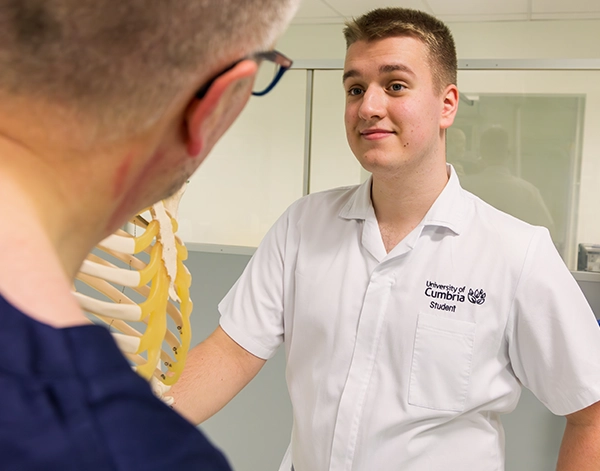
Throughout the year, you will also develop clinical skills within a Simulated Practice Environment to prepare you for real-world application. In addition, you will complete two placement allocations, both assessed against the NMC proficiencies. Successful completion of both placements is mandatory.
Year 2 of the FdSc Nursing Associate programme consists of 4 academic modules, totalling 120 credits, alongside two practice placements. Year two builds on the knowledge and skills developed in your first year, supporting your progression towards greater autonomy, confidence, and readiness for professional practice.
Throughout this year, you will further develop your ability to assess and respond to increasingly complex care needs. You will explore the principles of therapeutic communication, deepen your understanding of care across acute and community settings, and continue to examine the Nursing Associate’s role within the wider healthcare team. Empathy and person-centred practice remain central themes, with opportunities to understand the lived experiences of individuals and families navigating illness and healthcare.
Across the year, your learning will be reinforced through two practice placements, where you will continue to work towards meeting the NMC proficiencies. Successful completion of both placements is mandatory.
Please see Programme Specification
- Certificates must be provided to prove English (Language) and Maths to GCSE grades 4-9 or Functional Skills Level 2 or equivalent.
- 48 UCAS points or NVQ Level 3 or equivalent portfolio of evidence (as determined by the programme leader) please refer to the applicant information pages of the university website for more information.
- For APL, please refer to the university website. Each candidate will be dealt with on a case-by-case basis. A maximum 50% programme can be APL (NMC requirements)
- International students require an IELTS certificate that confirms a minimum score of 6.5 in writing alongside a minimum of 7.0 in reading, listening and speaking, so long as the minimum overall score of 7.0 (Access NMC link for more information) English language NMC requirements.
Personal statement - Applicants should demonstrate their motivation for the programme and reflect upon any practical experience they have gained. Experience in a setting that encompasses caring and/or interpersonal skills in either a formal or informal context is essential.
Degree apprenticeships are only offered to students undertaking the course as part of their employment. The apprenticeship training is therefore funded by the employer using their apprenticeship levy, with or without a contribution depending on the size and status of the organisation.
Apprentices will not be required to pay any fees and will not be eligible for Student Finance England maintenance support as they are in receipt of a salary. See further information on our Information for Aspiring Apprentices page.
The University will typically charge the maximum fee for the standard, before applying reductions based on accepted prior learning which is determined at application on an individual basis. To discuss sponsoring a learner on programme please contact apprenticeships@cumbria.ac.uk.