
Poppy Hall
BSc (Hons) Biomedical Science

BSc (Hons) Biomedical Science
Poppy chose to study Biomedical Science after discovering a real fascination with the human body during A‑level Biology. This sparked a curiosity to understand the biological processes behind health and disease, motivating her to pursue Biomedical Science in greater depth.
I chose to study Biomedical Science after developing a strong interest in the human body during my A-level Biology studies. Learning how the different organ systems work together to maintain health fascinated me and sparked my curiosity to understand the biological processes behind human health and disease in greater depth. This interest inspired me to pursue my degree in Biomedical Science, where I could further explore the science underpinning medicine and healthcare.
I have lived in Cumbria my whole life, and although I considered studying elsewhere, I ultimately decided that staying local was the best choice for me. I found the University of Cumbria to be particularly appealing because of its small class sizes, which provide greater opportunities for one-to-one tailored support from lecturers. The excellent laboratory facilities and the university’s location, just a few miles from the Lake District, further reinforced my decision to study here.
When I decided to study at the University of Cumbria, I was initially concerned that by living at home I would miss out on the traditional student experience. However, this was not the case. The university offers a wide range of societies and extracurricular activities, providing plenty of opportunities to meet new people and make new friends.
In addition, the level of support I received from my lecturers exceeded all my expectations. Every member of staff was genuinely committed to ensuring that students felt happy, supported, confident, and able to succeed. Their willingness to dedicate time to helping both me and my peers, whether during lectures or outside of class, was a very welcome surprise and made a significant difference to my university experience.
I really enjoyed the course because it offered a great balance of theoretical and practical work, ensuring that a wide range of interests were catered for. I have always been particularly interested in genetics, so the Human Genetics and Advanced Genetics modules were especially enjoyable for me. However, I also found the Biochemistry modules really interesting, despite being very challenging.
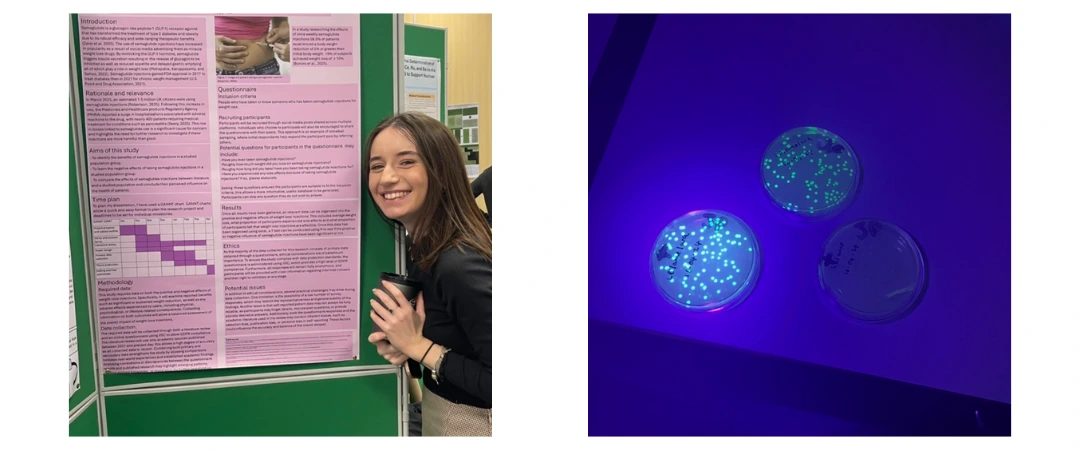
The standout part of my degree was definitely my dissertation, which focused on the health effects of semaglutide injections. This research project allowed me to explore a novel and rapidly evolving area of study while developing my ability to work independently. Having complete ownership of the project gave me the freedom to investigate a topic I was genuinely interested in and passionate about, making it one of the most rewarding and memorable experiences of my degree.
I thoroughly enjoyed my time at university, but the highlight of my experience was the friendships I developed. Throughout my course, I was fortunate to be part of a close-knit group of girls who provided unwavering support and encouragement. We all motivated one another through the challenges of the course, celebrated each other's achievements, and pushed each other to improve. Having such a strong support network not only made my university experience more enjoyable but also helped me grow in confidence.
I would describe the University of Cumbria as a welcoming and highly supportive institution that genuinely prioritises its students. The university places great importance on both students' academic achievement and their wellbeing, by ensuring that support is available whenever it is needed. Throughout my time here, I always felt encouraged to succeed academically while also being supported on a personal level, creating a positive and inclusive learning environment.
My favourite thing about living in Cumbria is its close proximity to the Lake District. On my days off from university, or after finishing lectures, I would often go walking with my dog. Spending time outdoors gave me the opportunity to relax, maintain a healthy work–life balance, and take a break from the demands of my studies.
During my time at university, I experienced a great deal of anxiety. This was driven by several factors, including the pressure I placed on myself to achieve the best grades possible and feelings of imposter syndrome. At times, I also felt underestimated by some of my classmates. As someone who is naturally outgoing, bubbly, and sociable, I often felt that people assumed I was less academically capable than I actually was. This affected my confidence and made me question my own abilities significantly.
After discussing these feelings with my personal tutor, I was reminded that the opinions of others do not define my intelligence or my potential. His support encouraged me to focus on my own progress rather than comparing myself to those around me. I realised that I had begun to tone down my personality in an attempt to fit the expectations of others. Once I recognised that I was at university to achieve my own goals and not to seek validation from others, I stopped trying to please everyone and embraced being my authentic self. This shift in mindset significantly improved my confidence and allowed me to focus my energy on my studies, personal growth, and the meaningful relationships I had built throughout my time at university.
During my time at university, I worked at a supermarket in my hometown alongside my studies. Balancing part-time work with my degree enabled me to earn my own income and develop a greater sense of independence. It also strengthened my time management, organisation, and prioritisation skills, as I learned to balance work, university, and my personal life effectively. In addition, the income I earned allowed me to reward myself after periods of hard work by taking trips away, giving me the opportunity to relax and maintain a healthy work–life balance.

I received a great deal of support from my personal tutor and course lecturers throughout my time at university. I found this support particularly valuable because the relationships I developed with them went beyond purely academic guidance. Having lecturers who knew me personally meant they understood my individual needs, challenges, and goals, allowing them to provide tailored advice and encouragement.
If I were to give myself one piece of advice before starting university, it would be to talk to everyone. The time to introduce myself and engage with others would have helped me realise sooner that I was not alone in my worries. Building relationships from the beginning can make the transition into university life much more enjoyable and reassuring.
I have secured a place on a Postgraduate Certificate in Education (PGCE) programme with Carlisle Schools Alliance, which will allow me to begin my journey towards becoming a secondary school science teacher. The University of Cumbria provided me with the knowledge, skills, and support needed to graduate with first-class honours, placing me in a strong position to progress into teacher training.
Learn more about our Science and Conservation courses at the University of Cumbria.