
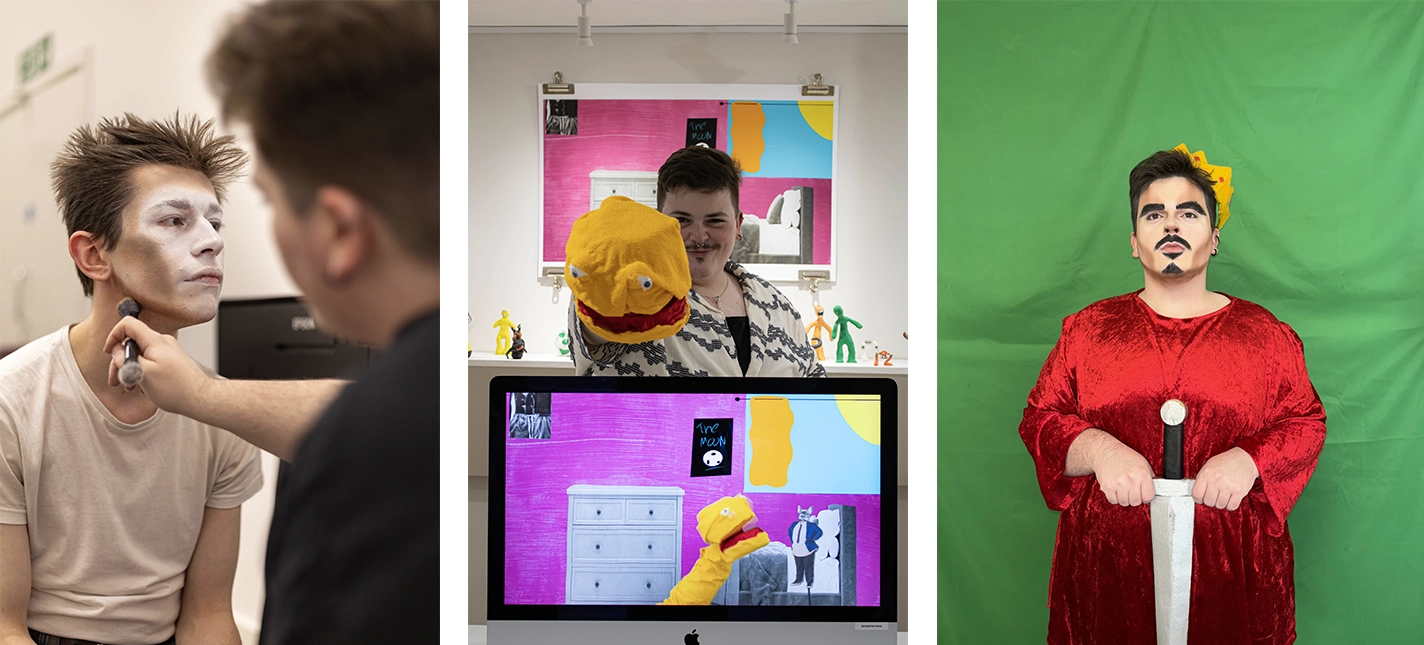
Meet Aidan, a graduate of our BA (Hons) Fine Art with Integrated Foundation Year course! Below, Aidan explains why he applied to the University of Cumbria through Clearing, what the process was like, and what he enjoyed most about his time here.
Why did you choose to study your course – what or who inspired you?
I studied BA (Hons) Fine Art with Integrated Foundation Year (IFY) and I applied through Clearing during the summer of 2021.
Why did you apply through Clearing, and did you understand how Clearing worked before you went through the process? If so, what did you know about it?
I had gone to a different university the previous year and felt it was the wrong decision, so the choice to come to the University of Cumbria was incredibly last minute. I had never heard of Clearing before. When Clearing was recommended to me, I immediately decided that the best option would be to ring the campus I wanted to study at (Brampton Road) to learn more and speak to the staff here at the University of Cumbria.
How was your Clearing experience at the University of Cumbria? How did you apply?
My Clearing experience was straight forward, and I felt fully supported by the amazing faculty. I applied initially via phone call and the whole experience was honestly so simple and easy. I would say the main thing to know before you apply is what your course of interest entails!
Would you recommend applying through Clearing to others?
100%. Sometimes it does take a while to figure out what you want to study, and Clearing is a great option in that regard.
What made you choose your undergraduate course, and who or what influenced that decision?
The location of the campus I studied at was great, as it was local to where I’m from. Initially, it was just me testing out whether I wanted to return to university. I had gone to another university before and really didn’t enjoy it, so this was a way of testing the water to see if coming back to higher education was the right decision. The support I received during the Clearing process was excellent and very straightforward. The level of care and contact I received reassured me that this was the right place for me.
I chose the BA (Hons) Fine Art course because I felt it would give me the opportunity to explore a wide range of creative areas. I was interested in graphic design and film, but I realised that fine art would allow me to expand my skill set more broadly. Through my conversations with the lecturers, I got the sense that fine art was a very flexible course where you can really choose your own direction. You get out of it what you put into it.
The course is very self‑driven – you set your own work. It’s a great opportunity to discover a lot about yourself: how you work, what you enjoy working with, and what kind of creative practice suits you. That all ties in well with the experience of preparing for the art shows and degree exhibitions. You always have that in the back of your mind – finishing second year and preparing for your exhibition, then reaching the end of third year and showcasing your work in the big final exhibition.
Did you have any opportunities for work placements, volunteering, or part-time jobs during your studies? How did this enhance your experience?
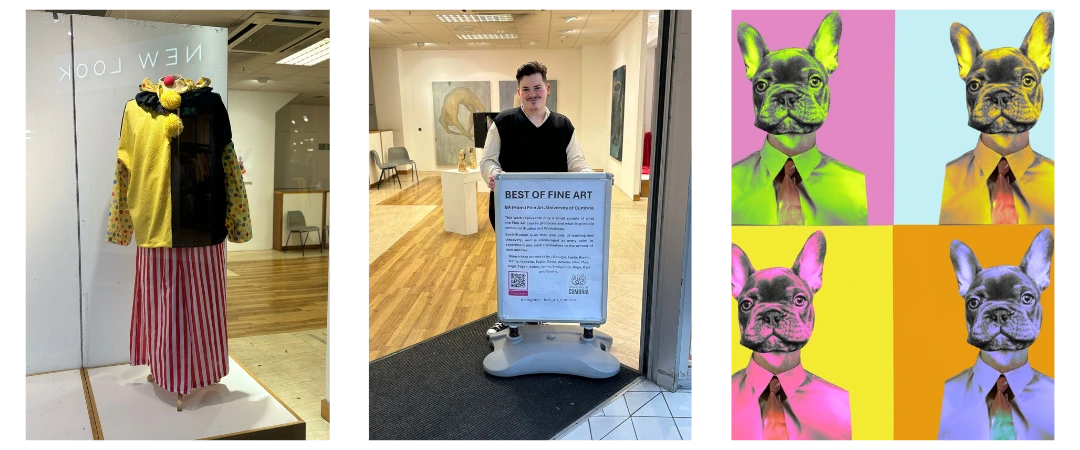
There were definitely opportunities available, and through the course I was able to develop the skills that helped me secure a number of them. For example, I’ve had my work displayed publicly in The Lanes Shopping Centre in Carlisle and at the Arts@60 Exhibition. I even have artwork exhibited in Spain, which came about through building my skills and confidence during the course.
The course equipped me with the skills, portfolio, and confidence to pursue these types of opportunities. The artist‑in‑residence, Paul, also arranges a lot of things and is a great support in helping students get their work out there.
I also currently have artwork displayed in the canteen at the Carlisle Fusehill Street campus, which has been another great experience. All of these opportunities have really enhanced my studies by giving me real‑world exposure, helping me understand how to present my work publicly, and building my confidence as an artist.
What did you enjoy most about studying Fine Art?
I had a really good experience on the course, and my tutors were great. The emotional and personal support I received academically made a huge difference. The art world involves a lot of writing, but at its core it’s about emotion, portrayal, and creation – and my tutors really understood that balance.
The lecturers were great at guiding us without ever taking control of our work. They would point you in a direction or explain how to shape your ideas so they aligned better with the assessment criteria, but they never dictated what your work should be. Their feedback was always supportive rather than restrictive.
I’m quite adaptable when it comes to my work, so I was able to take on board their feedback, apply it, and still produce artwork that felt true to me. That combination of creative freedom, emotional support, and constructive guidance really helped me grow as an artist.
What support services did you find helpful, whether academic, mental health, career guidance, or any other support received?
I received a range of support during my studies, both academically and personally. I had a very difficult experience during my foundation year involving my family, and the moment my lecturer found out, he immediately offered support. That level of care stayed consistent throughout my time on the course, and it made a huge difference to how supported I felt.
Martin, our lecturer, was someone you could always talk to. If he was free, he would make time for you, and that was definitely my experience. I felt like I got on well with him, and knowing I could pull him aside for a chat whenever I needed to was incredibly reassuring.
I also received the Student Support Fund, which gave me an extra £1,000 a year. That was a huge benefit and really helped me get through financially. When you divide it across the year, it covered a good portion of my rent while I was living in accommodation, which meant I could focus more on buying supplies for my artwork. It’s a university fund you can apply for around November through a form on the Student Hub. It can be a bit lengthy because they ask for your bank statements, details of your income and outgoings, and the reasons you’re applying – but it’s worth it, and they work out how much support to allocate based on your situation.
Overall, I think I had a really strong support system throughout university. I was very lucky in that sense. Having my partner also meant I always felt supported at home, and because Fine Art is such a self‑directed course, having that stability around me made a big difference.
What was your highlight at university?
One of my biggest highlights was definitely the studio spaces at the Brampton Road campus. The whole campus has so many amazing creative areas, but the Fine Art studios in particular are something special. There are three huge, white‑walled, white‑floored, white‑ceilinged art spaces where you're given your own desk and your own section of wall. You can bring in all your materials, decorate your space, and really make it your own.
It’s the same in the graphic design and illustration suites, too – there’s this big central square in the middle of the building where everyone has their own workspace. Having that kind of dedicated, personal area makes such a difference. It creates a sense of ownership and freedom, and it’s one of the things that makes studying Fine Art at Brampton Road feel so unique. You can just walk in, settle into your space, and immediately feel ready to create.
What was your favourite thing about living in Carlisle?
Living in Carlisle was a relaxing experience, especially compared to bigger cities. Because it’s a smaller, more condensed place, everything feels close together and is easy to navigate. There’s the city centre, and the main nightlife area is Botchergate, which you can completely avoid if you’re not a big party‑goer. But if you do enjoy going out, you’ll still find people you click with and can have a good drink or a dance with. The size of the city actually makes it easier to find your niche socially.
One of the biggest benefits of living in Carlisle is how simple day‑to‑day life is. If you’re studying at either campus and working a part‑time job in the city centre, you don’t have to deal with long commutes, trams, tubes, or complicated transport. I worked at Primark throughout my studies, and when I lived at the Brampton Road campus, it was about a 20‑minute walk. When I moved closer to the Fusehill Street campus, it was around 15 minutes. Everything is manageable on foot, which makes life so much easier and less overwhelming. Carlisle is a great choice if you don’t want to feel overloaded by a huge city.
How did you end up working in the Students’ Union as the Wellbeing Officer, and what opportunities in your course helped prepare you for the role?
Honestly, the whole thing started in the most unexpected way. I was just scrolling through Instagram when I saw an advert saying something like, “Nominate yourself to be an Officer at the Union – paid position.” My first reaction was, Why would I do that? I scrolled past it… then scrolled back up and thought, You know what, let’s actually read this.
Once I read through the role description, it clicked. I’d really enjoyed my time at the university, and the Wellbeing Officer role felt like the perfect mix of everything I cared about. It’s a role where you can put on fun events, work directly with students, and support people in a real hands‑on way. One of the prerequisites was simply being a graduating student, so I thought, Well, that’s me, why not give it a go?
I got the role, had a fantastic first year, and now I’m heading into my second. The opportunities have been so varied. I’ve done everything from small events, like going around each campus running pumpkin‑carving sessions, to medium‑sized events like organising a ghost tour.
Then there are big events. I’ve spoken at student conferences, including one at Kendal College. I’ve been heavily involved in Welcome Week and the Freshers’ Fairs, and since I’m returning for a second year, I’ll be even more involved in setting everything up. I’ve also done loads of interviews—with marketing, BBC, ITV, and other unions—which has massively boosted my confidence.
My performing arts background definitely helps. Speaking at the AGM Ball or in front of large groups doesn’t faze me. But I will say this: nothing compares to the nerves of speaking at graduations. Even with all my stage experience, those speeches are the scariest because the event is so prestigious. Standing at the front, representing the Students’ Union and giving a speech on behalf of all students – it’s a huge moment. People who haven’t been part of the academic procession don’t realise just how intense it feels. But it’s also one of the most rewarding parts of the job.
What advice would you give to your first-week self or to students thinking about joining the university?
Absolutely make the most of the space you have. The studios give you so much room to work, experiment, and store your materials, so keep as much as you can in your desk or studio area rather than cluttering your house. Having a dedicated creative space makes a huge difference.
Make full use of the facilities too. Try everything – the sewing machines, printmaking, woodworking, metalworking, all of it. Even if your project doesn’t directly relate to those areas, use them at least once. Experience and experimentation will only expand your skills and confidence. The workshops and storage facilities are incredible, and taking advantage of them is one of the best things you can do for yourself as a Fine Art student.
Find your place in Clearing
Applying to the University of Cumbria through Clearing is a great way to discover new opportunities and find the perfect course for you. Visit our Clearing Hub for more information about our courses, the application process, and your next steps.