Click here to edit using the old editor
{"available": "entirely", "availability": {"status": {"Recruiting Status 26/27":"RP 26/27","Recruiting Status 27/28":"RP 27/28","Recruiting Status 25/26":"RP 25/26"}, "dates": [{"name":"January 2026","month":"January","year":2026},{"name":"January 2027","month":"January","year":2027},{"name":"January 2025","month":"January","year":2025}]}}

MSc - Medical Imaging (Ultrasound) Full-Time

With a UK-wide shortage of sonographers, there has never been a better time to study a Master's in Medical Imaging: Ultrasound.

Our intensive two-year MSc Ultrasound programme – accredited by the Consortium for the Accreditation of Sonographic Education (CASE) – is the perfect accelerated pathway of study to launch your career as a sonographer.

Apply Now Register Interest

Accredited by:

Accreditation logo

Consortium for the Accreditation of Sonographic Education (CASE)

Course Overview

On this two-year programme, you will develop the knowledge, clinical skills and professional behaviours required to work as a sonographer. Through a combination of simulation-based learning and extensive
clinical placements, you will apply theory to real-world practice and gain hands-on experience across a range of ultrasound settings.

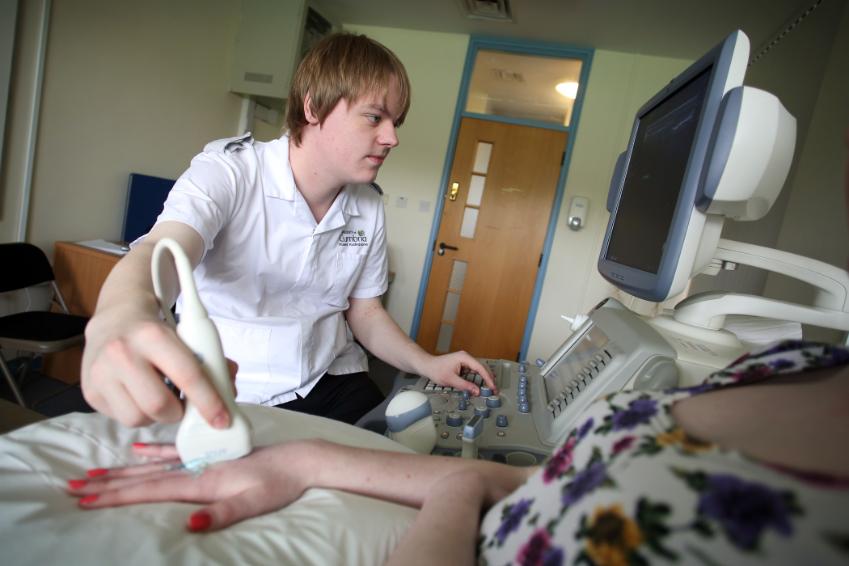
This programme gives you exposure to the full range of sonography in clinical areas such as obstetrics, gynaecology, general medical (abdominal and small parts), vascular, breast and musculoskeletal ultrasound training. Approximately 75% of your studies will be practical, so you will develop the work-based skills required to step into employment after graduation. The module delivery will be an online ‘blended’ learning approach and most modules will have an element of live virtual tutorial sessions.

On this course you will...

  • Learn the academic knowledge and the clinical skills required to work in the field of medical ultrasound. This will ensure you become a confident and competent ultrasound practitioner.
  • Working with a placement hospital, you will gain exposure to the full range of sonography specialisms, such as obstetrics, gynaecology, general medical (abdominal and small parts) and vascular.
  • Be welcomed from a range of healthcare and non-healthcare backgrounds. A healthcare background or degree is not required to gain a place on this programme.
  • Engage in practical training to gain work-based skills. You will have access to our cutting-edge ultrasound training hub, equipped with the latest ultrasound machines and an extensive ultrasound simulation facility.
Apply Now

Course Structure

What you will learn

At the beginning of the course, you will be introduced to the expectations of the whole pathway, including the two core modules and one clinical option, usually HMSU7066 (General Medical Ultrasound). Further in the course, two more clinical option modules are usually introduced: HMSU7064 (Obstetric Ultrasound) and HMSU7065 (Gynaecological Ultrasound). The Research Methods and Dissertation modules are usually completed in the second calendar year (of the 2-year full-time degree).

Each module is credit rated. You may be assessed in various ways including coursework, presentations, reflective writing, verbal assessments, exams and reports. Assessment of clinical placements is a requirement of the qualification and students will be assessed to ensure they are clinically competent before they can receive the award.

As this is a Full-time course, you will be attending either university or placement for approximately 37.5 hours a week. Much of your time on this course will be based in one of our partner NHS Trusts, and your
working hours may include evenings or weekends. There are some holiday weeks placed throughout the programme alongside some weeks designated for self-directed study.

Placements are provided with partner NHS Trusts in our region (whilst we will always consider your placement preference, please note that a specific placement location cannot be guaranteed). The clinical placement sites have been working with the university for many years, supporting students through the traditional part-time route for sonographers, and have friendly, supportive and experienced staff to help them develop their clinical skills whilst maintaining strong links with the university.

In certain circumstances, depending on placement capacity and your prior academic achievements/experiences, the clinical options may be subject to change and a further clinical option may be taken alongside a smaller dissertation.

Note: 'Sonographer' is not currently a protected title in the UK and at this present time graduates will NOT be eligible to be registered with the HCPC, although it is hoped that this will become a possibility in the future. For this reason, employment may not be possible in certain NHS trusts and some private sector organisations, although many organisations already employ sonographers from non-traditional backgrounds. Graduates from this programme/course will be eligible to join the Register of Clinical Technologists (RCT) accredited by the Professional Standards Authority (PSA).

Compulsory modules
  • Physical Principles & Technology in Ultrasound
    Develop a thorough knowledge and understanding of the complex scientific and safety principles required for safe clinical practice in medical ultrasound.
  • Professional, Legal & Ethical Issues in Ultrasound
    Develop a thorough knowledge and understanding of the complexities of the professional, legal, ethical and communication issues required for safe clinical practice in medical ultrasound.
Compulsory modules

The clinical modules on this pathway are chosen by the university and allocated placement provider. This may vary from placement to placement and year to year depending on the availability of training
provision. Clinical modules include:

  • General Medical Ultrasound (Theory)
    Develop a thorough knowledge and understanding of the complex anatomy and physiology relating to general medical ultrasound and the theoretical principles and applications of the more complex imaging techniques and associated pathology applied to this area.
  • General Medical Ultrasound (Clinical Practice)
    Demonstrate and apply the relevant knowledge, skills and professional abilities to effectively perform and interpret general medical ultrasound examinations, relating to the students agreed scope of practice.
  • Gynaecological Ultrasound (Theory)
    Develop an understanding of the fundamental anatomy and physiology of the pregnant and non-pregnant female reproductive system and the theoretical principles and applications of the routine imaging techniques applied to this area.
  • Gynaecological Ultrasound (Clinical Practice)
    Develop a thorough knowledge and understanding of the fundamental anatomy and physiology of the pregnant female pelvis and the theoretical principles and applications of the routine imaging techniques applied to this area.
  • Obstetric Ultrasound (Theory)
    Develop a thorough knowledge and understanding of the fundamental theoretical principles related to obstetric ultrasound applications.
  • Obstetric Ultrasound (Clinical Practice)
    Develop a thorough knowledge and understanding of the fundamental anatomy and physiology of the pregnant female pelvis and the theoretical principles and applications of the routine imaging techniques applied to this area.
  • Research Methods
    Select, devise, analyse and synthesise research and evidence-based practice findings.
  • Dissertation (60 credit)
    Carry out either a critical review of the current literature or a piece of empirical research, on an issue related to medical imaging/practice.

Attend an Open Day at Cumbria

An Open Day is your opportunity to explore one of 5 campuses, meet your lecturers, and find out how the University of Cumbria could become your new home.

Take the next step towards achieving your dreams.
A student stands in front of a wall splattered with paint.