Click here to edit using the old editor
{"available": "entirely", "availability": {"status": {"Recruiting Status 26/27":"RP 26/27","Recruiting Status 27/28":"RP 27/28","Recruiting Status 25/26":"RP 25/26"}, "dates": [{"name":"September 2026","month":"September","year":2026},{"name":"September 2027","month":"September","year":2027},{"name":"September 2025","month":"September","year":2025}]}}

BSc (Hons) - Computer Science (With sandwich placement)

Whether you're building the next generation of software, designing immersive games and multimedia platforms, or developing cybersecurity strategies and advanced networks, Computer Science is your gateway to limitless possibilities.

On our BSc (Hons) Computer Science with Sandwich Placement degree, you will explore artificial intelligence, cloud computing, and emerging technologies while developing the skills to shape how we live, learn, and connect: from smart systems to secure infrastructures, your journey into innovation starts here.

The addition of a sandwich placement—which you’ll undertake during year three of your studies—allows you to apply your learning in a real-world context. You’ll gain hands-on experience, build your professional network, and develop the confidence and capabilities to thrive in this dynamic sector.

Developed in collaboration with our partner BAE Systems, industry focus is embedded within every module, meaning you will gain exposure to industry experts within a professional setting. Over the 4 years, you will have the opportunity to work on technical projects designed to build upon your learning. In your final year, you will undertake a Professional Project; a substantial and independent piece of research into a topic of your choice, related to one of your taught modules.

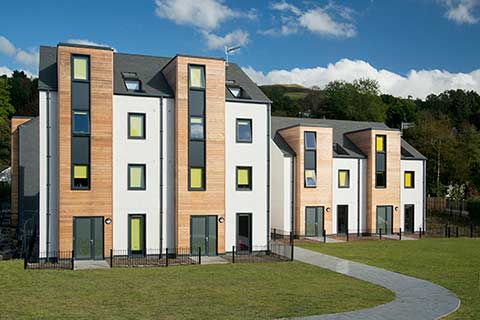
Our Computer Science course is taught at Lancaster or our brand-new Barrow campus, a purpose-built facility equipped with the latest resources and technology.

Apply Now Register Interest
Book an Open Day


Computer Science (With sandwich placement) cover image

Course Overview

Our BSc (Hons) Computer Science with Sandwich Placement degree, created in collaboration with BAE Systems, is designed to equip you with both the technical and professional skills needed to thrive in today’s job market. You will explore key areas such as software development, cybersecurity, and artificial intelligence (AI), all while fostering your creativity through innovation, hands-on experimentation and real-world examples.

In your first year, you'll build a strong foundation in computer science principles, including computer platforms and designing solutions for real business challenges.

The second year will deepen your understanding of computer networks, programming, data storage, and analysis, learning to create advanced software solutions.

You will undertake your sandwich placement in your third year. This year-long period of paid industrial training will help you to hone your expertise, try out a potential career path, and gain relevant and valuable workplace experience. In fact, many high-performing students return from their placement year with the offer of a sponsored Professional Project for their fourth-year studies and a graduate role within their organisation, so the sandwich placement can not only shape your degree journey but also your future after graduation.

In your final year, you’ll specialise in cutting-edge topics like AI, data science, or cybersecurity, alongside an industry-related Professional Project that enhances your practical experience, refining the skills and expertise that will fully prepare you for your future career.

While most of your learning will take place at our Lancaster campus, you’ll also have opportunities to engage with employers and participate in live projects through Enrichment Days at our new Barrow campus.

On this course you will...

  • Develop your professional skills alongside your academic study, with employability skills embedded throughout the programme.
  • Explore the broader responsibilities of computer professionals and their impact to society and the environment.
  • Benefit from engaging with stakeholders from local and national employers.
  • Study on a programme designed to meet the British Computer Society (BCS) accreditation requirements so that you become professionally recognised as a chartered IT professional.
  • Potential to apply for our exclusive funding schemes:
    Apply Now
    Book an Open Day

Course Structure

What you will learn

Computer science is a fast-paced and highly technical profession that demands a broad range of skills and knowledge. At each level of study, you will explore computers, computer systems, software and programming, as well as selected topics in business, management and leadership. Throughout the course, you will have the opportunity to contextualise your learning through project modules and enquiry-based learning.

Modules, Year one

In year one, the emphasis is on helping you become independent in your learning. You will study the fundamental concepts of computer science, including computer programming, data structures and algorithms, and computer architecture, and apply these techniques to solve well-defined problems.

  • Fundamentals of Computer Science & Programming
    This module introduces the fundamental principles of computer science. You will learn about how computers work, the basic building blocks of computer systems and how computers and computer systems are used in business and industry. You will also explore data, data communication and encryption.
  • Networking Fundamentals
    This module introduces the fundamental principles of networking, providing a practical and theoretical foundation for understanding computer systems and their interconnections. You will explore different network configurations and security considerations, gaining hands-on experience in setting up and troubleshooting networks.
  • Introduction to Computer Systems
    This module aims to develop your foundational understanding of computer systems through both theory and practical application. You will explore the evolution of computing, develop problem-solving and computational thinking skills, and study core concepts such as Boolean logic, computer hardware, operating systems, and system maintenance.
  • Information Systems Design
    You will find out how business functions, how computers are used to support this work, and learn how to understand business requirements to deliver an appropriate computer solution. As part of this, you'll be introduced to Unified Modelling Language (UML) to analyse, document and visualise systems.
  • Designing Computing Solutions
    You’ll learn about the fundamentals of systems and software to design, build and test your own software solutions. You’ll find out about the software development life cycle, and the processes of data integration, software testing methods and project management.
  • Web Development
    The main aim of this module is to develop a range of skills through an interesting and relevant project. You will work as part of a team to explore the processes required to develop, test and deploy a web-based app.
Year two

In Year 2, the emphasis is on building your confidence. Problems become more broadly defined and can involve various technical and commercial factors and constraints. In performing your analysis, and developing your solutions, you will draw on your new knowledge from across 5 in more advanced topics such as application development, network management, data science, software engineering and cyber security.

  • Application Development
    This module aims to develop your understanding and practical skills in designing and building software applications. It introduces a range of development environments, programming frameworks, and user interface design principles (e.g., usability and user experience).
  • Big Data & Data Science
    This module aims to develop your understanding of the principles and practices of data science and data analytics. It introduces key concepts in data processing, machine learning, and data visualisation, alongside practical skills in designing and implementing data-driven applications. You will explore the use of modern data science tools and frameworks, and how applied analytical techniques provide insights from large and complex datasets.
  • Database and Enterprise Systems
    This module aims to develop your understanding of the design, implementation and management of database and enterprise systems within modern organisations. It explores relational and non-relational database technologies, enterprise system architectures and the integration of data across business functions
  • Network Management & Administration
    This module aims to develop your practical and theoretical understanding of network management and administration. You will gain hands-on experience in configuring and managing a range of network devices and services, including routers, switches, servers, and wireless technologies.
  • Software Engineering
    This module is designed to build your proficiency in programming and software engineering. It emphasises the design, development, and testing of software solutions, with opportunities to explore applications that interact with hardware as well as purely software-based systems. You will be introduced to Agile methodologies to support collaborative, iterative development within team environments.
  • Cyber Security and Ethical Hacking
    This module aims to develop your understanding of core cybersecurity concepts and practices, with a focus on identifying threats, managing vulnerabilities and implementing effective security controls. You will gain hands-on experience in using industry tools to perform ethical hacking tasks, including reconnaissance, vulnerability scanning and basic penetration testing.
Year three
  • Sandwich placement year
Year four

In Year 3, you will engage with complex problems that are subject to some technical uncertainty. You will be creative and resourceful in applying a range of tools, theories and methods in a broad range of contexts. You will deepen your knowledge by studying specialised subjects including artificial intelligence, data science and cyber security. You will work on real-world projects, and your solutions will have immediate commercial value.

  • Professional Project
    The Professional Project is the capstone of your degree. You will undertake a substantial and independent piece of research into a topic of your choice, related to one of your taught modules in year 3.
  • Cyber-physical systems, Robotics & Autonomous Technologies
    This module aims to develop your theoretical and practical understanding of cyber-physical systems (CPS), focusing on the integration of technologies such as automated systems, robotics and mobile drones utilising Internet of Things (IoT). It also covers the boundaries and convergence of Information Technology (IT) and Operational Technology (OT).
  • Artificial Intelligence
    This module aims to provide you with a deep and practical understanding of Artificial Intelligence (AI) concepts, techniques and applications. It explores emerging areas of AI, including intelligent agents, search algorithms, reasoning, natural language processing and ethical AI. You will engage with real-world problems and develop intelligent systems using modern frameworks and tools, preparing you for careers in AI development, research and innovation.
  • Network Infrastructure Engineering
    This module aims to develop advanced knowledge and practical skills in designing, implementing, managing, and optimising enterprise-scale network infrastructures. You will explore the configuration and integration of key routing, switching, security, and redundancy technologies, alongside network management, monitoring, and automation approaches that support high availability, scalability, and performance.
  • Immersive Technologies
    This module introduces you to the rapidly evolving field of immersive technologies, including Virtual Reality (VR), Augmented Reality (AR), and Mixed Reality (MR). You will investigate how these technologies are applied across various industries (e.g., education, healthcare, engineering, creative media etc.) and explore their technical, innovative, and ethical implications.

Attend an Open Day at Cumbria

An Open Day is your opportunity to explore one of 5 campuses, meet your lecturers, and find out how the University of Cumbria could become your new home.

Take the next step towards achieving your dreams.
A student stands in front of a wall splattered with paint.