{"available": "entirely", "availability": {"status": {"Recruiting Status 26/27":"RP 26/27","Recruiting Status 27/28":"RP 27/28","Recruiting Status 25/26":"RP 25/26"}, "dates": [{"name":"September 2026","month":"September","year":2026},{"name":"September 2027","month":"September","year":2027},{"name":"September 2025","month":"September","year":2025}]}}
BSc (Hons)
-
Psychology
1st in the UK for student satisfaction (Guardian University Guide 2023)
Explore human behaviour and develop valuable graduate skills with our Psychology degree, accredited by the British Psychological Society (BPS).
This course provides an engaging exploration of human behaviour, cognition, advanced research methods, and hands-on experiential problem-based learning.
You will explore human experience across a range of contexts and lifespans, from understanding the biological basis of behaviour to questioning the impact of social media on child development. Part of your degree will be practical, focusing on research techniques, qualitative, quantitative, and mixed methods, data handling and analysis skills, laboratory reports, and communication skills.
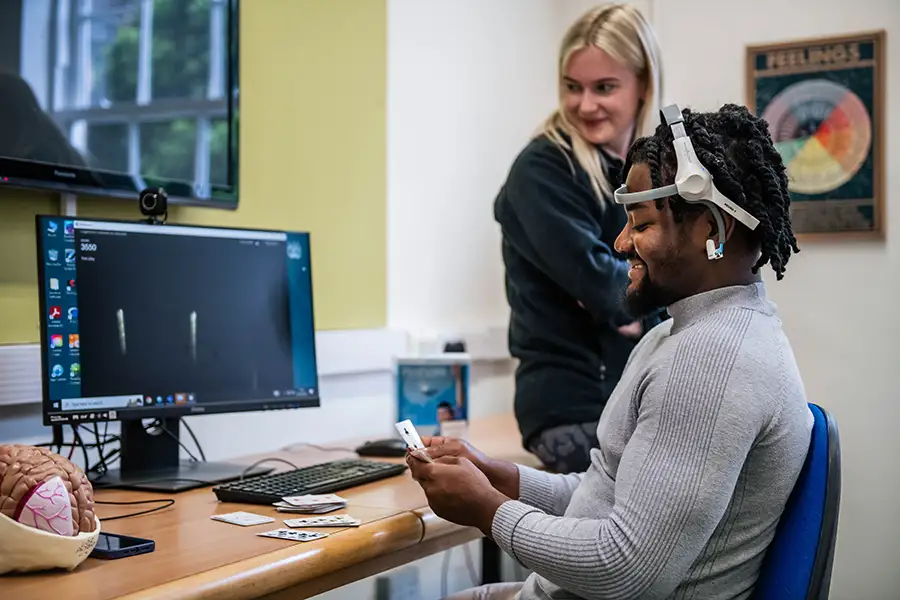
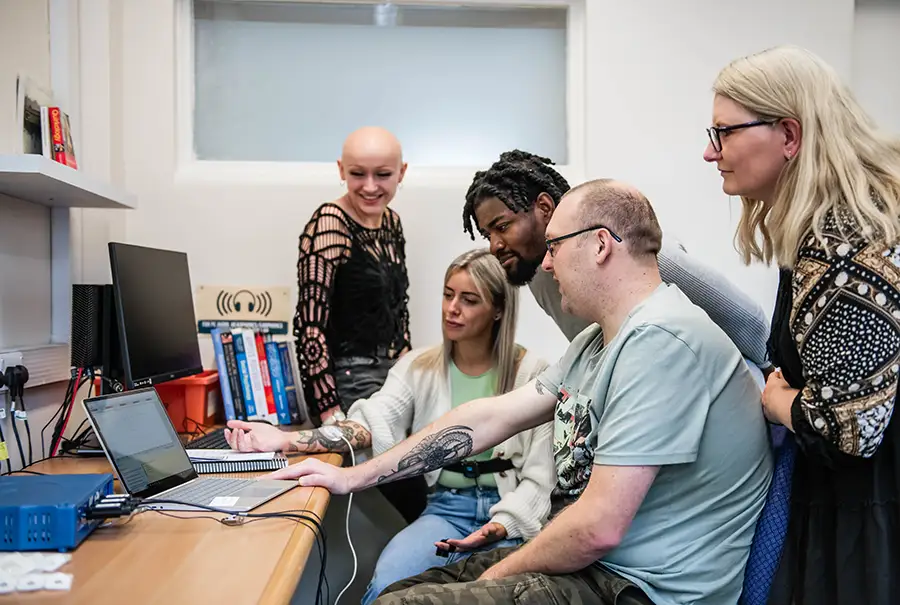
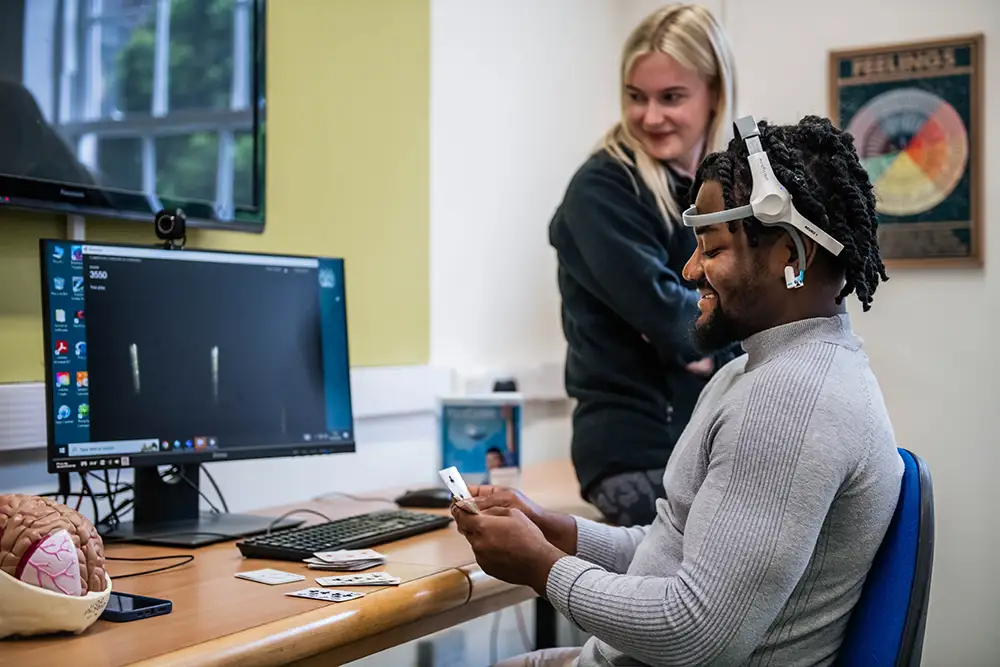
Our software and equipment for collecting experimental data includes the Biopac data acquisition system, MindWave Neurosky headsets, which are used to study and analyse brainwave patterns, and E-prime software for designing and running psychological experiments.
Lectures and seminars are taught by passionate academics, all of whom are researchers and practitioners, which allows you to benefit from their expertise and cutting-edge research. Our lecturers will get to know you individually to ensure you get the most out of your degree and feel supported throughout.
This degree programme is accredited by the British Psychological Society (BPS) and is designed to give you the knowledge and expertise to kickstart a successful career in Psychology. Upon completion of the course, you will also be eligible to apply for Graduate Basis for Chartership (GBC) with the BPS. The skills, knowledge and understanding you gain from the course will therefore help you access a range of rewarding professions within the field of psychology.
You’ll learn through a combination of lectures, seminars, and workshops delivered by our expert academics, and be encouraged to engage in career-enhancing voluntary work, giving you valuable hands-on experience that will allow you to graduate as a confident and knowledgeable practitioner. You will also attend seminars with national and international speakers and engage with real world research projects throughout your degree.
The course offers work experience in a range of areas, including working with young people, in schools, as part of research teams, within different charities, and supporting ex-offenders. We also offer a variety of extracurricular opportunities, such as voluntary research assistant roles, which have led to student publications and conference presentations.
This course is designed to allow you to tailor your degree based on your interests. Our Negotiated Learning allows you to pursue a supervised independent project on any psychological topic of your choice. Current students have explored areas such as clinical and forensic psychology, as well as educational and occupational psychology.
You will therefore be in the ideal position to take the next steps towards a career in clinical, forensic or educational psychology, health education and promotion, counselling, social work, teaching, organisational behaviour, human resources, and prison or probation work.
On this course you will...
Study psychology at the University of Cumbria, exploring and applying psychological literature to current issues, contexts and experiences.
Be taught and given high-quality support and guidance by our lecturing team, who are active in research and practices.
Learn valuable transferrable skills in research, which are highly sought after by employers.
Have the opportunity to choose topics and areas that you want to learn more about to tailor your learning experience.
Be able to shape your psychology degree experience to your interests and career goals, allowing us to help you to reach your ideal future career.
After attending the University of Cumbria open day I knew this was where I wanted to go. I liked the location, size and student diversity.
Lynda Kyle, Psychology
After owning her own business for thirteen years, Lynda changed her path and chose to re-enter full-time education. She is now succeeding as an undergraduate Psychology student at the University of Cumbria.
Studying Psychology is helping me to achieve my goal of becoming a Health Psychologist. Even though I still have a way to go, my passion for the profession is a great motivator, and I am enjoying being back in education with a clear aim.
Adam Muncaster, Psychology with Integrated Foundation Year
After struggling with his mental health upon leaving the military in 2016, Adam's University of Cumbria journey has seen him find his passion, grow in confidence and become a mental health advocate for others.
On this degree, you will study five key themes within psychology:
The contextualised bio-psychosocial nature of human development and experience
Ethical decision making and professional values
Gathering and analysing evidence using robust, population relevant and ethical research techniques
The pivotal role of academic, professional and graduate skills
Experiential problem-based learning
The following modules will take you through these themes, allowing you to investigate your independent interests in the curriculum.
Year one
In your first year, you will build knowledge in the foundations of psychology as a discipline and develop key skills through lectures, workshops and problem-based learning.
You will build knowledge of the history of the discipline, research methods and analytical techniques and learn about key theories and psychologists.
Psychology in Action Introduction to a range of theories and models from developmental, cognitive and biological psychology and their application to human contexts.
Introduction to Psychological Research Methods Introduction to the nature of psychological enquiry and research skills. Exploring quantitative and qualitative research methods, philosophical underpinnings and practical applications.
Introduction to Data Analysis Introduction to the processes involved in the analysis and interpretation of quantitative and qualitative data.
Perspectives in Psychology Introduction to a range of perspectives and key debates in psychology that aid in the understanding of individual and social phenomena.
Professional and Academic Skills Introduction to working with others in a professional setting, employability, and professional practice that includes listening skills and providing constructive feedback.
Introduction to Psychopathology
This module will provide a basis for diagnostic classification systems (e.g. Diagnostic and Statistical Manual of Mental Disorders (DSM)), and give an overview of the various different forms of psychopathology. It will outline theoretical frameworks which form the basis for assessment and intervention.
Year two
In the second year, you will develop a more in-depth understanding of research, theory, and practice, and develop research and practical skills.
This will include a work experience module, and an opportunity to engage in a negotiated learning project that is individually chosen and tailored to suit your particular interests.
Research Methods and Statistics Introduction to statistical techniques dealing with more than one independent variable at two or more levels, including within, between, and mixed participant designs.
Development, Brain and Cognition Explore the potential impact a range of factors have on human development and behaviour.
Research Methods in Applied Psychology Settings Introduction to a range of research designs used in psychology and applied psychology settings.
Work Experience The module will give you an opportunity to link your academic study with work experience. This will allow you to enhance your employability and develop your reflective writing skills through writing a report reflecting on your work experience.
Negotiated Learning This module permits you to independently undertake an agreed piece of work that is relevant to your own interests and/or career plans.
Social and Community Psychology Study theories of social psychology with the goal of understanding the experiences and behaviours of people within their community.
Year three
In your final year, you will undertake an independent research project that will allow you to explore a topic of interest and pursue your own research question.
You will also be able to further advance your knowledge of psychology and psychological skills.
Critical Psychology You will engage in a critical debate about the ideological basis of psychological knowledge, methods, and applications.
Individual Differences: Abilities, Personalities and measuring differences Introduction to the nature of individual differences in human behaviour across a wide spectrum of human development. With a specific focus on ability, personality and the use of Psychological testing to assess difference.
Dissertation You will pursue an investigation on a topic of your own interest.
Psychological Literacy and Careers The module will give you an opportunity to apply your psychological knowledge and skills to applied psychology settings. It will invite you to engage in an in-depth exploration of a career within, or allied to, psychology.
Counselling and Coaching Psychology This module includes the development of basic counselling and coaching skills to complement their developing employability skills and psychological literacy.
Teaching & Assessment
How you will learn
The curriculum will involve you in activities that promote engagement with a range of challenges and opportunities that extend beyond the classroom. Some of the activities that support this include:
Guest speaker sessions
Liaising with professional bodies
Staff-student research participation projects
Evening seminars
Psychology film clubs
We adopt a blended learning approach that involves a combination of face to face and online learning. We encourage you to collaborate remotely, share materials and discuss work outside of the classroom.
Please note that UK based laws, policies and regulations do dominate some parts of the curriculum. However, our curriculum does include a comparison between cultures and geographical locations, drawing on theory, research, policy, and practice from across the globe.
How you will be assessed
Assessments will support the development of skills, offer feedback and mark areas for improvement.
Assessment styles include:
Written assignments
Unseen in-class tests
Presentations and reports
Innovative and employability-focused tasks such as case study analysis, problem-based activities and reflective logs
In your first year, several modules involve a portfolio assessment model which enables you to develop and evidence a range of skills critical to success in years 2 and 3.
In each module, you have the opportunity to engage in summative and formative assessments. Summative assessment refers to work submitted for module and programme credit and is used to assess whether you have achieved the relevant learning outcomes in a module. Summative assessment is captured in the overall mark awarded for each module. Formative assessments occur in each of the modules to scaffold future summative assessments.
Overview
104-120 UCAS Tariff Points, You can find out more about the tariff and qualification options from the UCAS tariff table. Offers are tailored to the individual applicant and their circumstances and can be across the tariff range. Applicants who meet our contextual information criteria will be offered at the bottom of the range.
Qualifications
Entry Requirements
A-levels: BBC-BBB
T-levels: P (C+) – M. All subjects are accepted for entry to this course
Access to HE: 21 Credits at Distinction & 24 at Merit
Scottish Highers: BBBC - AABB
Irish LC Highers: B1x2, B2c C1 – B1x4
Alternative routes: If don't think you'll meet the criteria for direct application to this course, check out our Integrated Foundation Year
Fair Admissions
When you apply, our Admissions specialists will review your whole application. We are looking for your potential to succeed so will assess your qualifications, any relevant work experience, your personal statement, and references.
Where you have received a conditional offer subject to achieving particular grades/UCAS tariff scores, and do not quite meet these scores, please try not to worry, where vacancies exist our Admissions specialists will review your whole application again and take account of any mitigating circumstances and reassess your suitability for the course.
Selection Criteria
As part of the application and selection process, we are looking for your commitment to this programme. In your personal statement, you should demonstrate your motivation for choosing this course and reflect upon any experience you have gained.
Contextual Admissions
Going to higher education can transform a person’s life. We use contextual admissions to make sure that we are accessible to everyone who has the potential to succeed. Qualifications and grades are important, but they are considered alongside other information that helps universities to identify potential and widen access to university level study. For some individuals, the disadvantages they have experienced in their life mean that they have not been able to demonstrate their full academic potential. Where a person lives and their personal circumstances can all affect their educational attainment.
We take this context into account and look for an applicant’s potential when making admission decisions. The University of Cumbria will make offers at the bottom of any UCAS Tariff range to applicants that live in postal code regions with the lowest participation in Higher Education (Polar 4 quintile 1 – you can check your postcode here), applicants that are estranged from their parents, are care leavers or have caring responsibilities or are in receipt of or received free school meals during their secondary education. Attendance at our Masterclasses and Summer Schools will also allow applicants to receive an offer lower within the tariff range. (T&Cs apply)
If you are over 21 and returning to study after being in relevant employment for a minimum of 3 years and do not meet the published entry requirements for Year 1 of our degree courses, please do not assume you are not qualified to join us. Our experienced Admissions and Academic staff will review your prior qualifications and professional experience to support your application.
Language requirements
Please follow the link to check language requirements for this programme here.
Fees & Funding
Tuition Fees
UK Tuition fees
£9,535 Entry in academic year 2025/26
£9,790 Entry in academic year 2026/27
International Tuition fees
£14,900 Entry in academic year 2025/26
£16,000 Entry in academic year 2026/27
The figures above don't include accommodation and living costs.
Tuition fees are set annually and are subject to review each year. The University may therefore raise tuition fees in the second or subsequent years of a course, in line with inflation and/or the maximum permitted by law or Government policy. Students will be notified of any changes as soon as possible.
International Finance
At the University of Cumbria, we offer affordable tuition fees for international and EU students looking to study at one of our main four campuses. No matter your choice of course or career path, our International Team is here to support you.
We have a wide range of scholarships, bursaries, grants and funds available to support you throughout your studies with us. This includes the Cumbria Bursary - a non-repayable bursary designed to support first year students with a household income of less than £25,000..
You should budget for stationery and consumables for personal use. These may include notebooks, pens and pencils, digital storage devices, printing and photocopying. The amount you spend will depend on your study preferences.
Books and journals
Approximately £50 to £300 over the course of your studies
Optional · Throughout the course · Books and journals
Most core textbooks and journals are available through the University library. You may choose to purchase personal copies of books or other resources used to support your studies.
Some courses recommend particular books or provide an estimated annual budget for purchasing personal copies. Search for your course below for details.
Technology requirements
Cost depends on the equipment and internet service you choose
Required · Throughout the course · Digital learning and IT
You will need regular access to a laptop or computer capable of accessing the internet and running software such as a word processor and Microsoft Teams. Microsoft 365 is provided as part of your studies. You will also need a reliable internet connection. The amount you spend will depend on the equipment and internet service you choose.
British Psychological Society (BPS) student membership
£26
Optional · Per year · Professional membership and registration
You may choose to join the British Psychological Society (BPS) as a student member.
Conference attendance
Approximately £250 to £750 per conference, including fees, travel and accommodation
Optional · Variable · Other
You may choose to attend conferences that are not part of your course. Costs depend on the length of the event, the venue and the accommodation you choose. Many conferences are free for students.
Travel for study with a local prison
Approximately £60 to £100
Optional · One-off · Travel and accommodation · Year 1
If it is available to your year group, you may choose to study alongside prisoners from a local prison. You will need to pay for travel for 6 to 10 trips; students usually car-share to keep costs down.
BPS-accredited psychometric training
Approximately £400 to £600
Optional · One-off · Other · Year 1
You can choose to take BPS-accredited psychometric training in ability and personality testing, at around a third of the usual cost. It is separate from your degree.
Experience Psychology at Cumbria
Location
Carlisle - Fusehill Street Campus
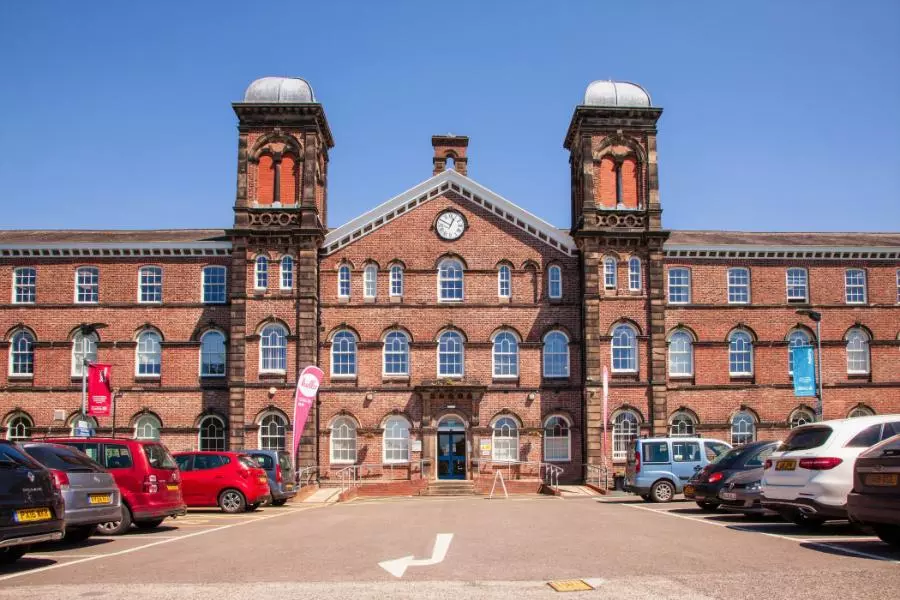
The Fusehill Street campus has been the setting of life-saving treatments since World War I. Now, it's home to world changers, life-savers, crime fighters, and entrepreneurs with access to high-quality facilities and innovative thinking.
An Open Day is your opportunity to explore one of 5 campuses, meet your lecturers, and find out how the University of Cumbria could become your new home.




-200x200.jpg)