Click here to edit using the old editor
{"available": "entirely", "availability": {"status": {"Recruiting Status 26/27":"RP 26/27","Recruiting Status 27/28":"RP 27/28","Recruiting Status 25/26":"RP 25/26"}, "dates": [{"name":"September 2026","month":"September","year":2026},{"name":"September 2027","month":"September","year":2027},{"name":"September 2025","month":"September","year":2025}]}}

BEng (Hons) - Mechanical Engineering (with year in Industry)

Step into the future of engineering with our BEng (Hons) Mechanical Engineering with Year in Industry.

This professionally focused degree combines academic excellence with valuable industry experience, giving you a competitive edge as you prepare to launch your career. Designed in collaboration with BAE Systems and aligned with real-world industry needs, the course blends rigorous technical education with practical, project-based learning.

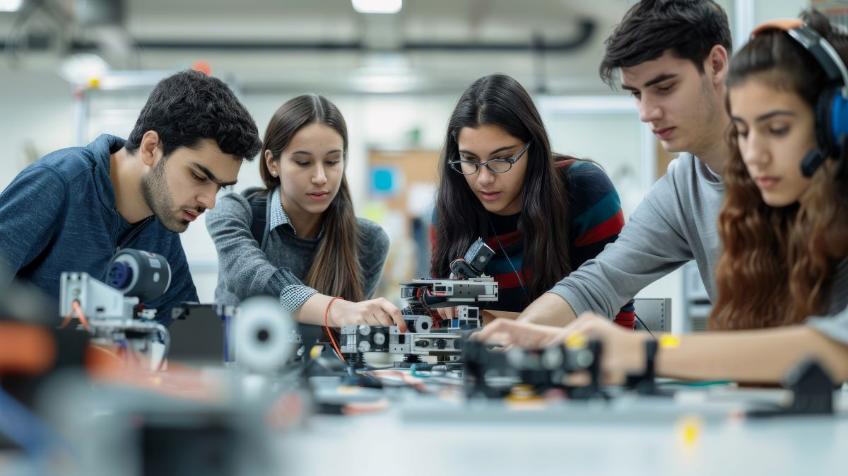
You’ll study in purpose-built facilities equipped with advanced technology—from robotics and 3D printing to CAD and automation systems—and learn from expert academic staff with strong links to industry. The addition of a structured year in industry gives you the opportunity to apply your learning in a real-world context, gaining hands-on experience, building your professional network, and developing the confidence and capabilities to thrive in the engineering sector.

The BEng (Hons) Mechanical Engineering with Year in Industry is a future-focused degree developed in partnership with BAE Systems, one of the UK’s leading engineering organisations. It provides you with a comprehensive foundation in core mechanical engineering principles and engages you with the latest technologies and practices driving the future of manufacturing and design.

You’ll study key areas including mechanics, thermodynamics, fluid dynamics, control systems, and materials science, alongside advanced tools and techniques such as 3D printing, robotics, and computer-aided design (CAD). Learning is brought to life through problem-solving, collaborative projects, and practical laboratory work.

In your second and third years, you’ll explore digital manufacturing, applied mechatronics, and automation, while your integrated engineering project will see you solving real-world challenges as part of a team. Your third year will be spent on a dedicated industrial placement, allowing you to apply your academic knowledge, gain professional experience, and enhance your employability before returning to complete your degree.

Apply Now Register Interest
Book an Open Day


Accreditation logo

Partnered with BAE Systems

Mechanical Engineering (with year in Industry) cover image

Course Overview

In your first year, you’ll focus on becoming an independent learner while building a strong foundation in engineering principles, mathematics, and design. You’ll learn to create and test engineering artefacts, explore materials and manufacturing processes, and gain essential knowledge of electrical and mechanical mechatronic principles.

In your second year, you’ll tackle more broadly defined challenges that require integrating knowledge from across your studies. You’ll deepen your understanding of applied mechatronics, materials and manufacturing, and digital manufacturing, while developing advanced modelling and simulation skills. Team-based projects will give you the opportunity to solve real-world engineering problems in a simulated professional environment.

Your third year will be spent on an industrial placement, applying your academic knowledge in a professional setting and gaining invaluable experience that enhances your employability. You can either source the placement yourself or our academic team can help you find a suitable placement.

In your final year, you’ll master complex engineering problems and explore advanced topics such as manufacturing systems, instrumentation and control, and cutting-edge materials technologies. You’ll also undertake a substantial independent engineering project, applying your skills
creatively to deliver solutions with real-world impact.

On this course you will...

  • Study in purpose-built facilities equipped with modern technology.
  • Learn from expert academics with strong industry links.
  • Gain a competitive edge through a year in industry and real-world projects.
  • Graduate ready to innovate and lead in the evolving engineering landscape.
Apply Now
Book an Open Day

Course Structure

What you will learn

This programme aims to develop your subject knowledge alongside your academic and personal development. You will be an active participant in your own learning, and your tutors will mentor and support you in applying your new skills in problem- and project-based modules. The new concepts and methods you will learn at each level of study will be linked by ‘design’, which is the creative application of technical subjects to solve a constrained problem.

Year one

In your first year, the emphasis is on helping you become independent in your learning. You will design engineering artefacts through standardised engineering science and mathematics application. You will be introduced to the fundamental principles of engineering science and solve well-defined problems.

  • Engineering Design
    In this module you will explore the tools and techniques of engineering design. You will be introduced to visual communication, the principles of metrology, and be trained in the safe use of a manufacturing workshop. You will put your new skills to use in the design, manufacture, and testing
  • Integrated Engineering
    This module will give you practical experience of delivering engineering design projects via problem-based learning. You'll be introduced to the broader context of engineering, including the social, ethical and environmental aspects.
  • Mathematics and Computing
    As an engineer, you will describe real-world systems using mathematics and analyse problems using computer simulation and modelling. In this module, you will begin your exploration of these subjects to understand how and why mathematics is essential in manufacturing engineering.
  • Principles of Materials and Manufacturing
    This module will introduce the fundamental properties of engineering materials, how they are manufactured, and how both aspects affect each other. In learning about these issues, you will gain confidence in making and justifying an engineering decision when no single correct answer exists.
  • Electromechanical Engineering
    This module introduces you to the foundational principles of electromechanical engineering often called Mechatronics, combining mechanical systems, electrical/electronic circuits, sensors and actuators, and basic embedded control.
  • Thermofluids
    This module introduces you to the foundational principles of electromechanical engineering often called Mechatronics, combining mechanical systems, electrical/electronic circuits, sensors and actuators, and basic embedded control.
Year two

In your second year, the emphasis is on building your confidence. Problems become more broadly defined and can involve various factors and constraints. In performing your analysis, and developing your designs, you will draw on your new knowledge from across your first and second years of study.

  • Applied Materials and Production Technologies
    This module builds upon your knowledge of materials properties and demonstrates how materials selection influences the design and manufacturing process. You will learn about the planning of standard manufacturing processes, which includes the use of computer-controlled machines.
  • Digital Manufacture and Smart Technologies
    This module explores current and future practices in manufacturing engineering organisations. You will be introduced to the organisation of engineering business, the core technologies of digital manufacturing and potential future trends, as well as add to your knowledge of formal project management.
  • Integrated Engineering 2
    This module allows you to integrate your learning from across level 5 in a simulated professional environment. You will engage in two substantial projects as part of a team to solve real-world manufacturing engineering problems where no single solution exists.
  • Mathematics and Modelling
    You will develop your ability to apply more advanced mathematical techniques in a range of realistic engineering problems. You will also develop an understanding of numerical techniques and use them in modelling and simulation real-world problems.
  • Robotic Engineering
    This module provides an introduction to industrial robotics and mechatronic systems, developing the understanding and practical competencies required for intermediate level automation and control. It extends Level 4 foundations in electromechanical engineering by integrating electrical machines, power conversion, sensing, actuation, motion control, and industrial control architectures within robotic applications.
  • Solid Mechanics
    This module develops the fundamental principles of solid mechanics and introduces you to the behaviour of deformable bodies under load. You will learn to analyse stress, strain, material response, and failure criteria in engineering components, with emphasis on practical calculation methods used in mechanical design.
Year three
  • Year in industry
Year four

In your fourth year, engineering problems become complex. You will be creative and resourceful in applying engineering science and new technologies to resolve wide-ranging problems and conflicting requirements and constraints. You will work on real-world projects, and your solutions will have immediate commercial value.

  • Advanced Manufacturing Systems
    You will expand your knowledge of contemporary manufacturing technology, which includes state-of-the-art computing. You will develop the analytical ability and technical skills to integrate manufacturing software, hardware, and controls into modern manufacturing systems.
  • Advanced Materials and Manufacturing
    You will explore leading-edge technologies involved in manufacturing processes, including contemporary issues in manufacturing engineering research. This includes advanced topics in metrology, additive layer manufacturing, and applications of artificial intelligence in manufacturing processes.
  • Advanced Instrumentation and Control
    You will gain in-depth knowledge of the requirements and challenges of integration of automated systems, and how to control their operations within the manufacturing environment. This will include mathematical modelling to represent electro-mechanical systems within the overall manufacturing system.
  • Integrated Engineering Project
    You will undertake a substantial and independent piece of research into a topic of your choice. This project will enable you to integrate the knowledge you have gained throughout your degree in a creative way to solve a real engineering problem, and enhance your employability skills.
  • Operations Management
    You will build upon your previous learning in Digital Manufacturing by exploring the theoretical, methodological, and practical approaches to managing manufacturing operations. In addition, you will learn how to apply your knowledge towards improving and transforming business operations.

Attend an Open Day at Cumbria

An Open Day is your opportunity to explore one of 5 campuses, meet your lecturers, and find out how the University of Cumbria could become your new home.

Take the next step towards achieving your dreams.
A student stands in front of a wall splattered with paint.